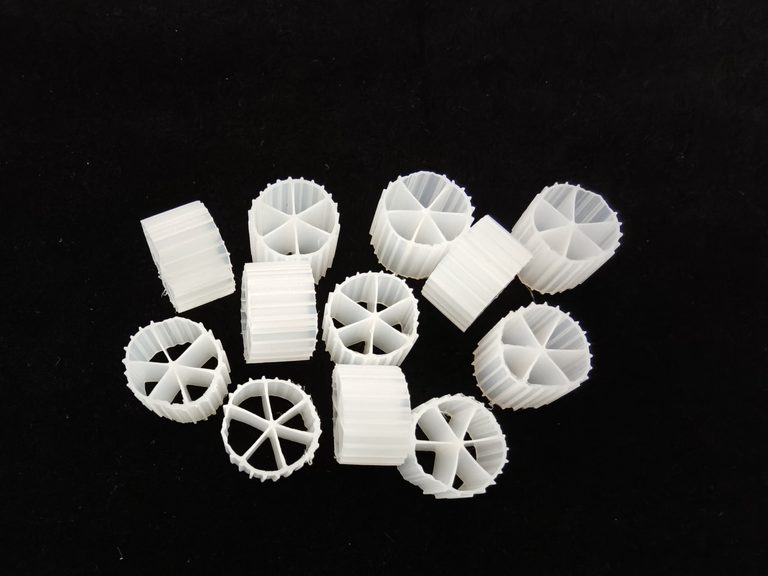
Finding MBBR carriers in the clarifier, the outlet channel or the pump sump is alarming — and the first instinct is usually to blame the media. In most cases that instinct is wrong: carriers are designed to stay in the reactor, so when they leave it, something that should hold them back has failed, or the water is pushing harder than the system was built for. The media is usually the victim, not the cause.
This article is a buyer’s diagnostic: the three causes behind most escapes, the checks to run in order, and what to specify when ordering replacement screens or media — so the fix lasts longer than the next high-flow day.
Cause 1: the retention screen has failed
The retention screen is the only thing standing between the carriers and the rest of the plant — and the part most often installed and then forgotten. Three failures recur.
Damage. A panel cracks, a weld breaks, a corner works loose. The damage is often small — a gap of a few millimetres is enough for a carrier to slip through — and often invisible from the walkway, hidden below the waterline or behind a baffle. If carriers are escaping, inspect the screen hands-on: drain the level down or lift the panel out, and look at every joint.
Wrong aperture. A screen sized for one media does not necessarily suit another. When a plant changes carrier — a different model, a different supplier, a top-up of smaller carriers mixed into the old stock — the aperture that once held the media can become a doorway. Before any top-up order, confirm the smallest dimension of the carrier you are adding against the screen aperture, in writing, with the supplier. This check is also the one most often skipped when a plant switches between plastic carriers and sponge media: the two behave differently, and the screen must suit the media actually in the tank.
Fixings and frames. Screens fail at their edges more often than in the middle: bolts corrode, gaskets shrink, a frame warps under load. A screen that looks intact from above can be open at the bottom corner where the flow is strongest. When you order a screen, the fixings and frame are part of the product — ask what they are made of, and how they are inspected.
If the screen is the cause, the repair is a screen, not new media. Replacing escaped carriers while the screen is still broken is pouring media into a drain.
Cause 2: the water is pushing too hard
The second cause is hydraulic: more water, or faster water, than the reactor and its screens were designed for — a production increase nobody told the treatment plant about, storm water entering the system, a pump replaced with a larger one, a flow split sending the full flow through one tank while the other is down for maintenance.
The signs are consistent: escapes clustering around high-flow events, carriers piling against the screen rather than circulating freely, water levels running higher than usual. The fix is not a better screen — a screen can only hold back so much force — but a look at the flow itself: what the peak actually is, how long it lasts, and whether the plant can absorb it, such as an equalisation tank or a flow split that works when one train is offline.
Before ordering anything, measure the flow when escapes happen. A supplier asked to quote a screen without knowing the peak flow is being asked to guess, and the guess will be wrong in the direction that costs you carriers.
Cause 3: the fill ratio is too high
The third cause is the simplest and the easiest to overlook: too much media in the tank. HNS fill ratios run 15–65% of the tank volume, and the top of that range is a design limit, not a target. Beyond it, carriers have nowhere to move: they pack against each other and the screen, ride up with the water level, and find their way over or through the retention system.
Overfilling usually happens gradually — a top-up to replace media lost in an earlier escape, then another, until the tank holds more than it was designed for. Each top-up feels small; the total is not. The check is arithmetic, not inspection: the volume of media in the tank against the tank volume and the design fill ratio. If you do not know the volume in the tank, establish it first — weigh a sample, or count it by the container it arrived in — before ordering more.
The checks, in order
Work through this sequence before spending anything. Most escapes are found in the first two steps.
| Step | Check | What it tells you |
|---|---|---|
| 1 | Inspect the retention screen hands-on — every panel, joint and fixing | Whether the barrier itself has failed, and where |
| 2 | Confirm the screen aperture against the smallest dimension of the media in the tank | Whether a media change or top-up opened a gap |
| 3 | Work out the fill volume against the design fill ratio (15–65%) | Whether the tank is overfilled |
| 4 | Record the flow when escapes happen — peak, duration, what caused it | Whether hydraulics are pushing carriers out |
| 5 | Check the aeration and mixing | Whether dead zones or surges are driving carriers to the screen |
| 6 | Look downstream — clarifier, pumps, pipework | How far carriers have travelled, and what else they may have damaged |
If step 1 finds a broken screen, fix it before doing anything else. If the screen is sound and the fill ratio is right, the answer is almost always flow — and the fix belongs to the flow, not the media. Note what you find at each step, with photographs: a supplier who sees the evidence quotes a solution; one who only hears “carriers are escaping” quotes a guess.
What to specify when you order
Whether the fix is a new screen, a repair, or replacement media, get these points into the enquiry in writing.
Screen specification. The aperture, stated against the media it must retain — not “fine” or “standard”, but a number, and the media model it was checked against. The material, confirmed for your water chemistry: a screen that corrodes in your water has a short life, so ask the supplier to confirm the grade in writing rather than accepting a catalogue default. The frame and fixings, with their material stated, and the inspection access — can the panel be lifted out without draining the tank?
Media specification. The model, the volume in cubic metres, and the smallest dimension of the carrier — the number the screen aperture is checked against. If you are topping up an existing tank, send the existing media model and a photograph, so the new media matches what is already there. Mixed media of different sizes in one tank is a common cause of the aperture problem above.
Spares and inspection. A spare screen panel, or at least the fixings and gasket set, kept on site — a screen that cannot be repaired quickly leaks carriers for a week. And an acceptance check: screen fitted, tank refilled, plant run at normal flow, no carriers downstream before the final payment is released.
For the sizing logic behind screen selection — aperture, open area and flow velocity — our technical team sets it out on Hydronovus: MBBR media retention screen sizing. The engineering and the purchase are two halves of one decision: the sizing says what the screen must do, the order says what you will hold the supplier to.
What to send HNS for a quotation
A carrier-loss quotation is only as good as the information behind it. Send the following, and the comparison between suppliers becomes a comparison of real offers:
- Media model and the volume in the tank, in cubic metres — and the fill ratio, if you know it
- Photographs of the screen, the damage if any, and the carriers found downstream
- The screen aperture as installed, if known, and the smallest dimension of your media
- Flow data: average and peak, and what happens to the flow when escapes occur
- Tank dimensions and access: how the screen is reached, and whether the tank can be isolated for repair
- Water chemistry, if the screen material may be the issue — chloride levels in particular
If the problem turns out to be flow rather than the screen, we will say so. A new screen sold to a plant that needs flow control is a sale we would rather not make.
The bottom line
Carriers in the clarifier are a symptom, not a verdict on the media. Check the screen first, then the aperture against the media, then the fill ratio, then the flow — in that order — and fix what you find. And when you order, order the numbers: aperture against carrier size, material confirmed for your water, spares on site, and an acceptance check with the plant running.
Send your photographs, media model and flow data to HNS through our contact page and we will quote the screen or the replacement media against the numbers, not the guess. For the media itself, see our MBBR media range and the MBBR system overview for how carriers, screens and aeration hold together — or the clarifier upgrade pages if escaped carriers have reached the clarifier and it needs attention too.