The plant was fine for a year, then the effluent started slipping, and under the tank cover the carriers looked wrong — grey and heavy, coated in a pale crust, or slick with grease. The question that follows is always the same: do we need a cleaning system?
Fair question — but the second one. The first is what is on the carriers, and why it is there. Cleaning removes the deposit; it does nothing about the cause, and a system bought for the wrong cause is money spent on a symptom that comes straight back. This article works through the decision in the order a buyer should make it: identify the fouling, decide whether cleaning is the right fix, then specify the system.
What fouling looks like, and why it hurts
Three deposits do most of the damage.
Scale is a hard mineral crust, usually calcium carbonate, that forms when hard water meets the warm, aerated conditions of an MBBR tank. It adds weight, so carriers that once moved freely start to sink or sit still, and coats the protected surface where the biofilm lives.
Grease and oil arrive as a film. Food, dairy, slaughterhouse and oily industrial effluents all carry fats that coat carriers in a slick layer, starving the biofilm underneath of oxygen and substrate, and the carriers clump together instead of moving separately. It often shows up first as uneven movement — some carriers circulating, others stuck in dead zones.
Excess biofilm and solids build up when the load is high, the aeration is weak, or the tank has run a long time without a check: carriers get heavy and sluggish, biofilm turns thick and pale instead of thin and brown. Thick biofilm is usually a symptom — too much load, too little air — rather than a cleaning problem on its own.
The common thread is movement: an MBBR works because the carriers move and the biofilm stays thin and active. If your carriers have stopped fluidising, the technical reasons are set out on Hydronovus: why MBBR media floats, sinks or stops fluidising. Cleaning is one answer there — but only when the deposit is the actual problem.
When cleaning is the wrong purchase
Before spending anything, check whether the deposit is a cause or a consequence — three checks save more money than any cleaning system.
First, look upstream. Grease fouling with no grease removal upstream returns within weeks of cleaning, however good it was. If the plant has no trap, screen or DAF ahead of the MBBR and the effluent carries fats, the money belongs upstream. The same applies to scale: very hard water with nothing to soften it, and the crust reforms. Cleaning without an upstream fix is a subscription, not a solution.
Second, check the load and the air. Carriers overloaded with biofilm usually point to a load the tank was not sized for, or aeration that has fallen off — a blower problem, a fouled diffuser, a valve left half-closed. Clean the carriers, change nothing else, and the biofilm grows straight back. Fix the air or the load first.
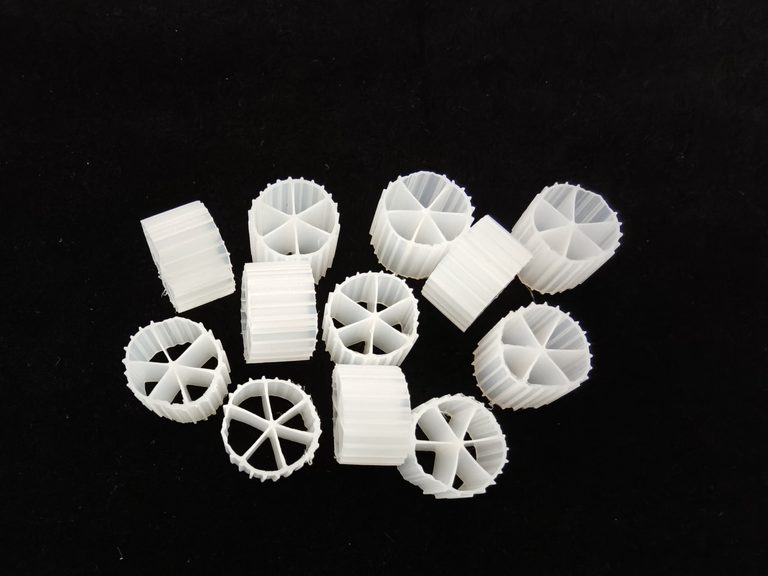
Third, check the media itself. Sponge media and plastic carriers do not clean the same way. Our NovusPore sponge carries its biofilm inside a porous structure — over 5,000 m²/m³ of surface, more than 98% porosity, biofilm established in 3–7 days — and harsh mechanical cleaning can damage it; a top-up is normally expected after about five years, not a deep clean. Plastic HDPE carriers are tougher, but high-pressure jets and harsh chemicals can still crack or deform them, and a cracked carrier will eventually escape the tank. Ask the supplier in writing which cleaning methods are safe for your media before you buy anything.
If all three checks pass, a cleaning system is a sensible purchase. If any check fails, fix that first, and the cleaning question may answer itself.
The cleaning methods, and what each one demands
There is no single “MBBR cleaning system” — there are methods, differing mainly in how much of the plant must stop, and how much labour they take.
Air scour and water jets clean the carriers where they sit, using extra air or water pressure to knock deposits loose. They need the least downtime and handling, and suit light, regular fouling. Their limit is depth: they shift loose, soft deposits well and do little to a hard scale crust, and the loosened material must go somewhere — usually the downstream clarifier — so the plant must absorb a short solids peak.
Chemical soak means dosing a cleaning solution into the MBBR tank, or an isolated section of it, and letting it dissolve the deposit. This suits scale and grease that will not shift mechanically, but it stops treatment while it runs: the biology is exposed too, and the tank must be brought back carefully — solution neutralised or flushed, biofilm given time to recover. Ask the supplier to state the chemical, concentration, contact time, neutralisation step and expected recovery time — in writing, before you order.
Ex-situ removal means taking the carriers out, washing them in a separate vessel or on a screen, and returning them — the most thorough method and the most disruptive: tank access, lifting or pumping equipment, a place to wash, and a plan for the wash water. It also needs the fill volume known: carriers are quoted by the cubic metre, and a job that discovers twice the expected volume halfway through is an expensive surprise. This suits a planned shutdown, not a quick fix.
None of these methods is “the” answer: the right one depends on the deposit, the media, tank access and affordable downtime. A supplier who quotes before asking those questions is quoting a product, not a solution.
What to ask before you order a cleaning system
Use this checklist in the enquiry and ask for the answers in writing.
| Question | Why it matters |
|---|---|
| What deposit is on the carriers — scale, grease, or excess biofilm? | The method follows the deposit — a jet that clears grease will not touch scale |
| What is the cause, and is it fixed? | Cleaning without fixing the cause is a subscription |
| What media is it — plastic HDPE or sponge — and which methods are safe for it? | Harsh cleaning can damage sponge media and crack plastic carriers |
| What is the fill volume, and the fill ratio? | Job size, wash-water volume and price all follow the volume; HNS fill ratios run 15–65% |
| Can the tank be isolated, or must treatment continue? | Decides whether in-situ or ex-situ cleaning is possible |
| How much downtime can the plant afford? | A soak or a removal needs a shutdown window; scour needs almost none |
| Where does the wash water go? | It carries the removed deposit and any chemical — it needs a permitted route |
| What is the expected recovery time? | After a chemical clean the biofilm needs time to re-establish — plan the trial period around it |
| What spares and consumables are included? | Nozzles, hoses, chemicals, seals — price them now, not during the first clean |
| What does the supplier guarantee? | Not a performance percentage — a written statement of what the method removes and what it does not |
First, ask for a trial: a supplier confident in their method should clean a sample volume first — a small batch of carriers, removed and returned — so you can see the result before committing to the whole tank. Second, get the method in writing in the order: chemical named, contact time stated, recovery period agreed. Cleaning is a process, not a product, and the order should describe the process.
What to send HNS for a quotation
Send the following, and the comparison between suppliers becomes a comparison of real offers:
- Media type and model — plastic HDPE carrier or NovusPore sponge — and fill volume in cubic metres
- Photographs of the fouled carriers, in the tank and lifted out
- Water data: hardness, oil and grease, incoming solids, pH, and any grease removal or softening upstream
- What has already been tried — scouring, jetting, chemical dosing — and what happened
- Tank access, whether the tank can be isolated, and the shutdown window available
- Whether this is a one-off clean or a recurring service you want priced as a package
If the check shows the problem is really upstream — no grease removal, or a DAF that needs attention — we will say so and quote that instead. A cleaning system sold to a plant that needs a grease trap is a sale we would rather not make.
The bottom line
Clean the carriers when the deposit is the problem, the cause is understood, and the media can take the method. Do not buy a cleaning system to treat a symptom whose cause sits upstream, or a load or air problem wearing a fouling costume. When you do buy, buy the method, not the machine: deposit identified, chemical named, downtime agreed, trial batch cleaned first.
Send your photographs, media type and water data to HNS through our contact page and we will tell you honestly whether cleaning is the right purchase — and if it is, quote the method that fits your media, tank and shutdown window. For the media itself, see our MBBR media range and NovusPore sponge media pages, or the MBBR system overview for how carriers, screens and aeration work together.