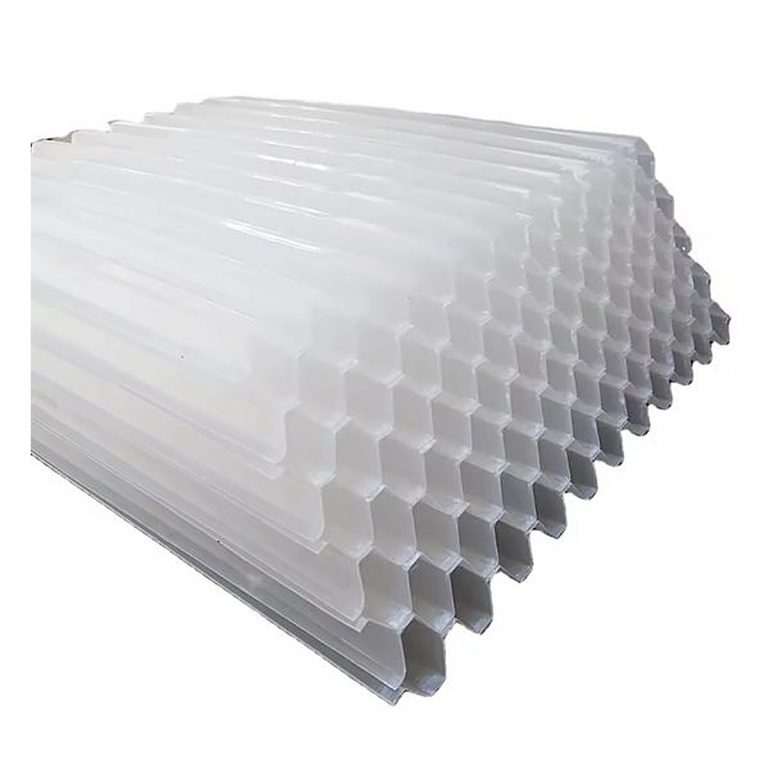
Two carriers sit on your desk. Same shape, same size, same weight in the hand. One is moulded from virgin HDPE resin. The other has recycled content blended in. Can you tell which is which?
You cannot. Not by eye, not by feel, and not by any simple test on a loading dock. That single fact should shape how you buy MBBR media: material is the one part of the specification you cannot inspect at delivery, so it has to be bought on paper — declared, specified, and kept on file — not judged by how the pieces look.
Colour is the opposite problem. Buyers read meaning into it that is not there. Black must be stronger. White must be cleaner. Neither is true, and this guide explains why, so you can spend your attention on the figures that actually decide how media performs and how long it lasts.
What “100% virgin HDPE” means for a buyer
Virgin resin is new material, produced for moulding, with known and consistent properties. Our full carrier range — MBBR19, 37, 64, 76, 40, 04, 05 and 06 — is moulded from 100% virgin HDPE, with a density of 0.96–0.98 and a catalogue service life above 15 years.
For a buyer, “virgin” is not a luxury label. It means three practical things:
- Consistency from bag to bag and order to order. The material going into the mould is the same material every time, so wall thickness, weight and behaviour in the tank stay predictable across a large fill — and across a top-up order placed years later.
- No unknown history. Recycled resin has already lived one life. What it was, what it carried, and how many heat cycles it has been through are unknown. Blended into a carrier, that history is invisible — until pieces age unevenly.
- A specification that can be written down. Virgin HDPE with a stated density range is a checkable promise. “Good quality plastic” is not.
None of this means every recycled-content carrier fails. It means the risk cannot be inspected away. When a quote is cheaper because the resin is cheaper, the saving is real and immediate; the cost, if the material ages badly, arrives years later as a re-fill — media, freight, and downtime together. Buyers comparing quotes line by line should treat the material declaration as a line item, not a footnote. (Choosing between models by surface area is a separate question — our guide to reading an MBBR media datasheet covers that, and the technical selection view is on our sister site: MBBR media selection by surface area.)
Why recycled content is a risk you cannot see
It is worth being precise about the problem, because suppliers of recycled-content media will tell you the pieces look identical. They are right. That is the problem.
- You cannot verify resin origin by looking. A carrier gives no visual clue about what its resin was before it became a carrier. Certificates and declarations are the only evidence, which is why they have to be asked for before the order, not after a dispute.
- Blends vary. Recycled content is rarely 100% of the mix, and the share can drift between batches. Two deliveries of the “same” media can behave differently, and neither you nor the supplier may know why.
- Ageing shows up late. Media lives in aerated water for years, under constant movement and impact. Material weaknesses do not announce themselves at the receiving check; they appear as brittleness and breakage long after the invoice is settled.
The buying conclusion is modest and practical: if the price gap matters to your project, ask what share of recycled content is in the mix and get the answer in writing. If the supplier will not state the material at all, that silence is the answer.
Colour: the honest explanation
Carrier colour comes from masterbatch — a colour concentrate dosed into the resin during moulding. It changes the pigment. It does not change the polymer, the density, the surface area, or how the carrier performs in the tank. Our engineers confirm this plainly: colour is masterbatch only.
So black, white, blue or a custom colour are all the same carrier wearing a different coat. Choose colour for reasons that are actually real:
- Identification. Different colours make it easy to tell models or fill stages apart in the same plant — MBBR19 in one tank, MBBR37 in another, a later top-up in a third colour so you can see at a glance what went in when.
- Habit and visibility. Some operators prefer light pieces because biofilm growth is easier to see on them during inspections; some prefer dark pieces in open tanks. Both are working preferences, not performance differences.
- Your existing plant standard. If your site already runs one colour, matching it keeps inspections simple.
What colour should not do is decide the supplier. A quote that leans on colour as a quality argument is selling you pigment. Ask about resin and density instead.
Mixing media: where material discipline pays off twice
Most fills are not bought in one order. A plant starts with one delivery, tops up two years later, and extends a tank five years after that. If each order quietly changes material — a different resin blend here, a different maker there — the tank ends up holding a mixture that ages at different speeds. The oldest question in the plant becomes unanswerable: which batch is breaking up?
Material discipline makes top-ups boring, in the good way. Same supplier, same declared material, same model: the new bags behave like the old ones, and the fill ages as one fill. If you do change supplier, change deliberately — keep the reference sample of the old media (below), note the switch date and the zones filled, and treat the first top-up as a trial quantity before committing the whole top-up volume.
One more practical point: a suspiciously cheap quote for a top-up is worth a second look precisely because the pieces will be mixed with media you already trust. A weak batch does not stay separate in a moving bed. It spreads through the tank, and by the time breakage shows, nobody can say which delivery it came from — unless your records and reference samples can.
The figures you can actually hold a supplier to
Since resin origin cannot be eyeballed, build the order around what can be stated, delivered and checked:
- Material declaration, in writing. “100% virgin HDPE” on the quotation and the order — not just on a webpage. If recycled content is present, the share should be stated the same way.
- Density range. Our carriers run 0.96–0.98, just under the density of water, which is what keeps them suspended and moving in an aerated tank. Density is a real, testable figure — a supplier can certify it, and it is far harder to fake than a slogan.
- Model, size and surface area, per the catalogue. MBBR19 (>650 m²/m³, φ25×12 mm) is not MBBR76 (>1,600 m²/m³, φ25×4 mm). The model on the bag must match the model on the order — see the receiving checks below.
- Batch consistency. Ask how the supplier keeps batches consistent, and keep a reference sample from the first delivery (below). A top-up order three years later should match it.
Receiving checks a buyer can actually do
Forget float tests. Dropping a carrier in water tells you it floats today; it tells you nothing reliable about resin origin or how the piece ages. The checks that work are boring and documentary:
- Weigh a bag against the stated packing. Our carriers ship at 0.1 m³ per bag. A bag that is light against the stated volume is a short or inconsistent fill, whatever the resin is.
- Read the model on the bag, not just the delivery note. Confirm every bag carries the model you ordered.
- Ask for the material certificate for the batch. This is a normal request on a media order. File it with the delivery note.
- Keep one unopened bag as a reference sample, label intact. If a question arises in year three — about material, model or consistency — that bag settles it in one message.
Our full receiving, storage and first-fill checklist walks through the delivery-day routine step by step.
What to send HNS for an MBBR media quotation
Send the tank working volume, the model you are considering (or the duty, if you want us to suggest one), and the fill ratio you are working to — our catalogue dosing range is 15–65% of tank volume. If material matters to your project, say so, and we will put the declaration on the quotation: 100% virgin HDPE, density 0.96–0.98, the model and its catalogue surface area. If you want a specific colour for identification, tell us — we will treat it as what it is, a labelling choice, and quote the same carrier.
We manufacture the MBBR carrier range and the NovusPore sponge media at our own factory in Yixing. We supply media and equipment packages — not whole-plant process design, civil works, commissioning, or operation. Send the details through our contact page, and the material basis will be in writing on the offer, where it belongs.