
A screw press can look compact on a drawing.
That does not mean the sludge dewatering room should be designed around the machine footprint alone.
In many wastewater projects, the equipment itself fits easily into the available area. The problems appear later: operators cannot reach key components, polymer equipment has nowhere to go, sludge containers cannot be changed easily, or major parts cannot be removed during maintenance.
For EPC contractors and wastewater plant operators, a practical sludge dewatering room should therefore be planned around the complete operating process, not just the length and width of the screw press.
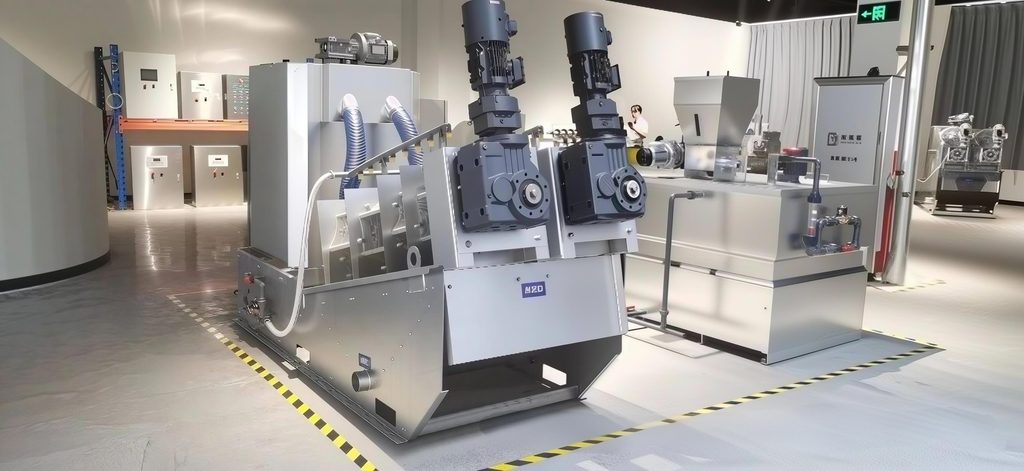
1. Start with the complete sludge dewatering process
Before fixing the room dimensions, first confirm how sludge will move through the system.
A typical arrangement may include:
Sludge feed → Conditioning / flocculation → Screw press dewatering → Sludge discharge → Final handling or disposal
Depending on the project, the system may also include:
- Sludge thickening
- Polymer preparation and dosing
- Mixing or flocculation tank
- Sludge pumps
- Screw conveyor
- Sludge bin or bulk bag
- Wash-water system
- Control panel
This is why the actual space requirement is usually larger than the footprint shown on the screw press datasheet.
2. Leave enough space for operation and maintenance
A screw press is a mechanical system that needs regular inspection and maintenance.
Operators may need access to:
- Screw and dewatering section
- Spray-cleaning system
- Motor and gearbox
- Piping and valves
- Polymer dosing points
- Electrical components
- Sludge discharge area
If the machine is installed too close to a wall or another piece of equipment, routine work can become difficult.
A layout should therefore consider not only where the machine stands, but also:
Which side needs to be opened?
Which components may need to be removed?
Can an operator safely reach the service points?
For preliminary planning, clearance around the machine can be reviewed first, but the final maintenance space should always be confirmed according to the actual equipment configuration.
3. Do not forget polymer preparation and sludge conditioning
Mechanical dewatering performance depends heavily on sludge characteristics.
In many projects, polymer conditioning is required before sludge enters the screw press.
This means the dewatering room may also need space for:
- Polymer preparation unit
- Dosing pump
- Chemical storage
- Mixing tank
- Flocculation tank
- Operator access for chemical refill and maintenance
This part is often underestimated during early layout design.
A screw press may occupy relatively little floor space, while the complete conditioning and dosing system requires additional operating area.
4. Sludge discharge arrangement can change the whole layout
The discharge side of the screw press is one of the most important parts of the room design.
Different sludge handling methods require different space.
Bulk bag or container collection
If the dewatered sludge is discharged into a bag or container, check:
- Container dimensions
- Replacement access
- Forklift access
- Temporary storage area
- Discharge height
Screw conveyor
If a conveyor is installed after the screw press, confirm:
- Conveyor direction
- Length
- Inclination
- Drive position
- Maintenance clearance
- Final discharge point
Sludge truck or larger collection system
For larger plants, the layout may need to consider vehicle access, loading position and the route used to remove dewatered sludge from the building.
The correct question is therefore not only:
“Where will the screw press be installed?”
It is also:
“How will the dewatered sludge leave the system?”
5. Check installation access before finalizing the room
A machine that fits inside the room still needs to get into the room.
Before construction or equipment delivery, check:
- Door dimensions
- Access route
- Turning space
- Floor loading
- Lifting points
- Crane or forklift access
- Ceiling height
- Future removal route
This is especially important for retrofit projects.
Existing buildings often contain piping, columns, cable trays or other equipment that reduce the real installation space.
Major maintenance should also be considered.
If the motor, gearbox or dewatering section needs to be removed in the future, there must be enough room to do so without dismantling half of the plant.
6. Confirm sludge conditions before selecting the screw press
Room layout and equipment selection should not be separated from process conditions.
Before recommending a screw press, several project parameters should be confirmed.
Key information includes:
- Sludge flow rate
- Feed solids concentration
- Sludge source
- Operating hours per day
- Sludge characteristics
- Required final handling method
- Available installation space
- Polymer availability
- Discharge arrangement
One important point is feed solids concentration.
Very dilute sludge may require thickening before mechanical dewatering.
A screw press should not be selected simply because sludge volume is high.
The sludge concentration and dewatering objective need to be reviewed first.
7. A practical checklist for sludge dewatering room planning
Before finalizing the room, check the following:
| Item | What to confirm |
|---|---|
| Screw press | Final model and actual dimensions |
| Sludge feed | Flow and solids concentration |
| Conditioning | Polymer preparation and mixing requirements |
| Maintenance | Access on service sides |
| Sludge discharge | Bag, bin, conveyor or truck |
| Installation | Door, transport and lifting route |
| Utilities | Power, wash water and drainage |
| Future service | Space for major component removal |
This simple checklist can prevent many layout problems later.
8. Compact equipment does not mean minimal space
One of the advantages of a screw press is its relatively compact configuration.
But reducing the room size too aggressively can create higher operating costs later.
A good sludge dewatering room should make it easy to:
- Operate
- Inspect
- Clean
- Maintain
- Replace parts
- Remove sludge
- Upgrade equipment later
The objective is not to create the smallest possible room.
The objective is to create a layout that remains practical throughout the equipment’s operating life.
Final Thoughts
When planning a sludge dewatering room, the screw press footprint is only the starting point.
A practical layout should consider:
Equipment size + sludge conditioning + maintenance access + sludge discharge + installation route + future servicing
For wastewater EPC contractors and plant operators, reviewing these factors early can reduce installation changes and make long-term operation much easier.
Planning a sludge dewatering project?
HNS Watertech can support preliminary screw press selection and equipment layout review based on your actual project conditions.
Send us:
- Sludge flow
- Feed solids concentration
- Operating hours
- Available installation space
- Planned sludge discharge method