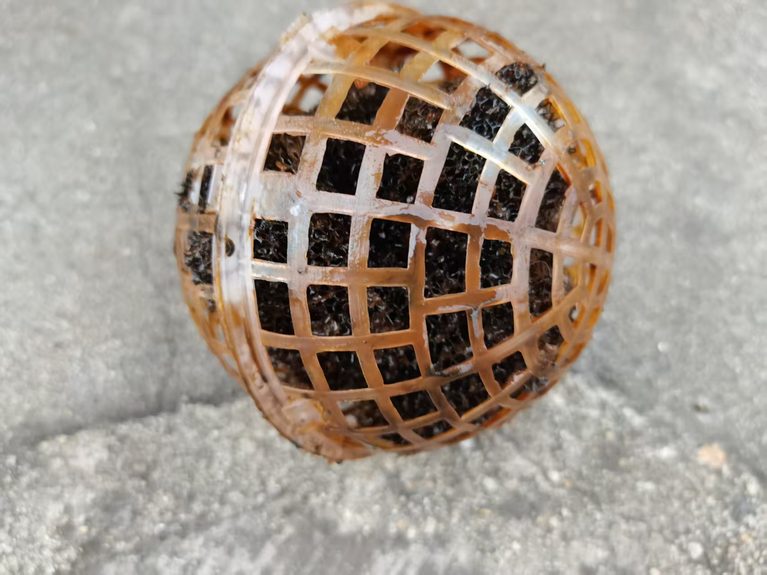
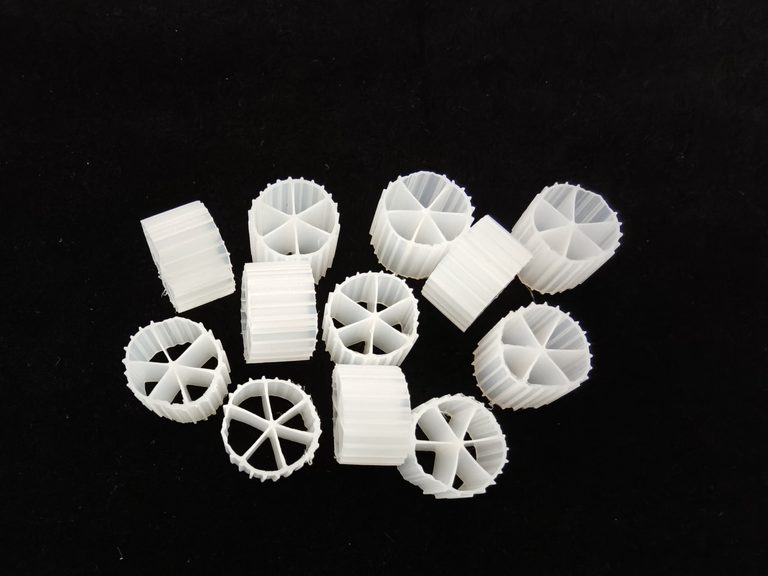
When an MBBR plant misbehaves, the media is the most visible component and the first suspect. Sometimes it is guilty. More often, the carriers are reporting a problem that lives somewhere else — in the screens, the aeration grid, or a load the plant was never sized for. Replacing media to fix an aeration problem buys you new media with the same problem.
Work through the symptom you actually have. Each entry gives the likely causes in the order to check them, the first check to run, and the fix — marked honestly as either an operations fix (no purchase) or a parts fix (something to order), because a troubleshooting guide that ends in a shopping list for every symptom is a catalogue wearing a disguise.
Symptom 1 — Carriers escaping downstream
Likely causes: retention screen slot wider than the carrier’s smallest dimension; gaps at the screen edges or around pipe penetrations; damaged screen panels; fill level so high that carriers ride over the screen at peak flow.
First check: Measure the slot against the carrier’s smallest dimension — not its diameter. A φ25 carrier can pass a slot lengthwise if its thickness is smaller than the opening. Then walk the screen perimeter with the tank at working level and look for edge gaps.
Fix: Parts fix, and a cheap one relative to lost media — replacement or corrected retention screens sized to the carrier. If carriers only escape at peak flow, check the fill ratio too: above roughly 65% of tank volume, circulation throws media at the screen harder than the design assumed.
Symptom 2 — Media floating and matting at the surface
Likely causes: new media not yet wetted or carrying no biofilm (biofilm adds the weight that settles carriers into the density band); gas bubbles trapped in a thick biofilm lifting carriers; aeration too weak or uneven to pull surface media back into circulation.
First check: How old is the fill? Carriers in their first days — biofilm formation takes 3–15 days — riding high is normal start-up behaviour, not a defect. On mature media, pull a handful: thick, gassy biofilm points to overloading or under-aeration, not bad plastic.
Fix: Operations fix in most cases — aeration pattern and load. Media density itself is specified at 0.96–0.98 g/cm³, just below water; a carrier only leaves that band if something (biofilm gas, scaling, attached grit) changes its effective weight, which is why the check is on the carrier’s coating, not the carrier.
Symptom 3 — Media sinking and piling in dead zones
Likely causes: aeration dead spots (blocked or damaged diffusers, uneven grid) letting carriers settle out of circulation; scaling or grit accumulation weighting carriers down; in older fills, carriers made from recycled material with uneven density — some sink from the day they are installed.
First check: Map the pile. Piles that sit over one section of the aeration grid are an air problem. Carriers sinking uniformly across the tank, in a fill that has done it since commissioning, are a material problem — squeeze and section one: brittle walls and inconsistent weight across a handful of carriers are the recycled-material signature.
Fix: Air-side piles — operations fix (diffuser cleaning or replacement membranes; a consumable, and usually the real purchase hiding inside a “media problem”). Uniform sinking in an old fill — parts fix: the fill itself, replaced with virgin-material carriers whose density is stated on the quotation.
Symptom 4 — Biofilm too thick, sloughing in sheets, effluent worse after
Likely causes: organic overload pushing fast-growing heterotrophs that smother the slower nitrifiers beneath; fill ratio too high for the aeration to keep carriers scouring each other; a shock load (chemical spill, pH excursion) killing film that then detaches wholesale.
First check: What changed upstream in the last month — production, cleaning chemicals, a new waste stream? Sloughing that follows a plant event is biology responding to the event. Chronic thick film with no event points at load vs. installed surface area: the sizing question, not the media question.
Fix: Operations first (load management, aeration). If the arithmetic says the installed surface area is simply short for the current load, the parts fix is a top-up — which is why plants designed with fill headroom (Symptom 1’s 65% ceiling, used in reverse) can respond in weeks instead of a rebuild.
Symptom 5 — Ammonia creeping up while everything “looks fine”
Likely causes: water temperature falling (nitrification slows markedly below 10 °C — the winter effect, predictable and annual); slow loss of media volume over years through a damaged screen; biofilm present but the plant outgrown — load up, capacity static.
First check: Trend, don’t snapshot. Plot effluent ammonia against water temperature and influent load for the last season. Ammonia that tracks temperature is physics. Ammonia that tracks production is arithmetic. Both are cheaper to confirm on paper than in the tank.
Fix: Depends on the trend line — winter capacity is a sizing decision best made in autumn; gradual media loss is a screen inspection plus a top-up order sized from the current load, not the original design load.
The pattern underneath all five
Notice what the checks have in common: four of the five symptoms are usually diagnosed from measurements and a walk around the tank, and the media itself is the confirmed culprit in a minority of cases — mainly old fills of unverifiable material, and volume quietly lost or outgrown. That is not a defence of media suppliers; it is the order of operations that saves you money. Check air, screens and load first. Buy second.
If a check lands on a parts fix — retention screens, diffuser membranes, a top-up volume — send us the carrier dimensions, the tank size and the load data behind the symptom. We will size the part or the volume from the numbers, state the basis on the quotation, and tell you plainly if the numbers say the fault is not ours to sell you a fix for.
FAQ
How do I tell if my carriers are recycled material?
No single test is proof, but the cluster is telling: uneven weight carrier-to-carrier, brittle walls that crack rather than flex, density behaviour (sinking or floating) present from commissioning rather than developing in service. Virgin HDPE carriers from a stated grade behave uniformly across the batch.
Can I mix a top-up of new media into an old fill?
Yes — match the carrier size to your retention screens first, then the surface-area basis. New media needs its 3–15 days to grow biofilm, so a top-up raises capacity over weeks, not overnight.
My media is five years old and performance is slipping. Replace the lot?
HDPE carriers are a >15-year product; age alone is rarely the cause. Run the symptom checks first — the usual findings are screens, air, or a load the original fill was never sized for. Wholesale replacement is the last diagnosis, not the first.