You send an RFQ on Monday. On Tuesday you are wondering when the media will arrive. By Friday you are wondering whether the supplier has forgotten you. The anxiety is normal — and mostly unnecessary. An MBBR media order has a visible sequence of stages, and once you can see them, you can plan around them instead of guessing.
This article walks through that sequence: the six stages from RFQ to container, what happens in each one, what you control, and what actually slows an order down. It gives no promised delivery date, because no honest supplier can promise one before seeing your order. What it gives you is the structure to judge any date you are quoted — and to spot the supplier who cannot explain their own timeline.
The Six Stages, in Order
Stage 1: RFQ and quotation. You send your requirements; the supplier prices them. This stage is as fast as your RFQ is complete. A quotation needs five numbers: the model or models, the quantity in cubic metres, the delivery destination, the packing, and your target date. Send all five and a quotation normally comes back within a few working days. Send two of them and the stage stretches into a week of questions. Our guide to exactly what to send is Before You Ask for an MBBR Quotation: The 5 Numbers That Decide Your Price — read it before you write the RFQ, not after.
Stage 2: Sample and confirmation. For a first order, a sample is the stage buyers most often try to skip — and the stage that saves the most trouble. A small sample pack lets you check the material, the size, and the finish before a container is moulded. Our sample guide explains what to check: Testing a Media Sample: What to Check on MBBR and Sponge Samples Before You Commit. Samples ship by courier, not by container, so this stage runs in days, not weeks — but it does need your time. A sample that sits unopened on a desk for two weeks adds two weeks to the order, and that delay belongs to the buyer, not the factory.
Stage 3: Order confirmation and payment. The order is confirmed when the proforma invoice is accepted and the deposit is paid. Production scheduling starts here, not at the RFQ. This is the single most misunderstood point in the whole timeline: a quotation is not a production slot. We have seen buyers hold a quotation for a month, pay, and then ask why production has not started. It starts when the payment lands. Our payment and terms guide covers what to put in writing at this stage: Payment Terms, Warranty and Inspection: What to Put in Your Equipment Order.
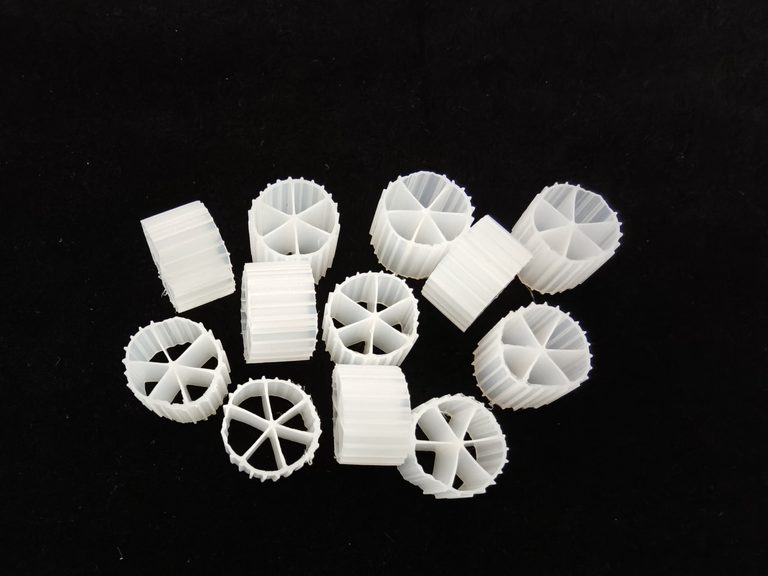
Stage 4: Production. The factory moulds, checks, and bags the media. Standard MBBR carriers are packed at 0.1 m³ per bag, and a full container holds 30 m³ in a 20-foot box, 60 m³ in a 40-foot box, and 70 m³ in a 40-foot high-cube. Production time depends on the quantity, the model mix, and what else is in the schedule — a single model in a full container runs faster than five models split across the same volume, because every model change is a mould change. If your order shares a production run with other orders — as samples sometimes do, cut from the next bulk run — the start date depends on that run, and an honest supplier will tell you so rather than invent a date.
Stage 5: Inspection and loading. Before the container leaves, the goods are counted, the packing is checked, and the container is loaded and sealed. If you asked for a third-party inspection, this is when it happens — add its scheduling to your plan, because inspectors book up too. Count the bags on the loading photos against the packing list: 0.1 m³ per bag makes the arithmetic easy, and a mismatch caught at loading is a phone call, while a mismatch caught at your warehouse is a claim.
Stage 6: Shipping. The container leaves the port and the ocean transit begins. Transit time is set by the route, not by the supplier, and it varies by destination, season, and the sailing schedule. Your supplier should give you the vessel name, the sailing date, and the bill of lading — and you should track it yourself rather than wait for updates. Freight cost, and why it differs so much between media types, is covered in our container comparison: Freight Cost: MBBR vs Sponge Media, Container by Container.
When the container arrives, the timeline is not quite over. The media still has to be installed and the biofilm started. For what that stage involves, the technical guide on our sister site is the right reference: MBBR startup and biofilm commissioning.
What Actually Slows an Order Down
In our experience, three things cause most delays — and all three sit with the buyer.
An incomplete RFQ. The supplier cannot price what you have not specified. Model, quantity, destination, packing, target date: five answers, and every missing one costs a round of emails. The quotation guide linked above exists because this is the most common delay in the whole process.
A sample round that never ends. One sample round is normal. Three rounds of small changes — a slightly different colour, a slightly different size — is a development project wearing an order’s clothes. Decide what the sample must prove, test it, and move on. If you need a different carrier, say so at the start, not after the third sample.
Payment timing. Production is scheduled against paid orders. A deposit that arrives two weeks after the order confirmation moves production two weeks. This is not a supplier being difficult; it is a factory with a queue. If your internal approval for the deposit takes time, start it when you send the RFQ, not when the proforma invoice arrives.
Two more delays are worth knowing about because they look like supplier problems and are not. The first is container availability: at peak season, a booked container can roll to the next sailing, and no supplier controls that. The second is your own receiving: a container that arrives while your site is unprepared waits at the port, and port storage is not free. Confirm your receiving arrangements — unloading crew, storage space, and who signs for the goods — before the vessel sails, not after it docks.
A Planning Table You Can Use
Use this table to plan your order backwards from the date you need the media on site.
| Stage | Who acts | What you should prepare |
|---|---|---|
| RFQ and quotation | You send, supplier prices | Model, quantity, destination, packing, target date |
| Sample and confirmation | Both | Time to test the sample; a decision, not a delay |
| Order and payment | You pay, supplier schedules | Deposit approval started early; terms agreed in writing |
| Production | Factory | One model mix, confirmed; no changes mid-run |
| Inspection and loading | Supplier, inspector if any | Inspector booked; bag count checked against packing list |
| Shipping | Carrier | Vessel details tracked; receiving arranged at destination |
| Start-up | You, with guidance | Installation crew and the commissioning steps ready |
The discipline is in the first three rows. Get the RFQ right, decide on the sample quickly, and pay on time, and the rest of the timeline mostly takes care of itself. Get any of the three wrong and no amount of chasing the factory recovers the time.
What to Send HNS for a Quotation
If you are ready to start, send us the same five items that open the timeline through our contact page: the MBBR models and quantities — see our MBBR media range — the delivery destination, the packing you need, and the date you are working towards. Tell us plainly if the date is fixed, for example a shutdown window, or flexible. A fixed date lets us plan production around it; a flexible date lets us fit your order into the most efficient run.
We manufacture MBBR media at our Yixing factory, and we will tell you the production position honestly: what is in the schedule, when your run can start once payment lands, and what the shipping step looks like for your route. What we will not do is promise a delivery date before we have seen your order — because a date invented at the quotation stage is the first delay in the order, disguised as a promise.
The Short Version
An MBBR media order runs RFQ, sample, payment, production, inspection, shipping. Production starts when payment lands, not when the quotation is issued. The three delays buyers control are an incomplete RFQ, an endless sample round, and a late deposit. Send the five numbers, decide on the sample, pay on time — and the container will be on its way while other buyers are still waiting for a revised quotation.