Ask three suppliers for a price on 60 cubic metres of MBBR media and the quotations will look close — close enough that you pick the lowest and move on. Then the freight invoice arrives, and the cheapest quotation becomes the most expensive delivery.
This happens because media is not sold the way it is shipped. You buy it by the cubic metre. You ship it by the container. And the number of cubic metres that fit in a container depends on the product, the packing, and decisions the supplier made long before your order. For a buyer comparing MBBR carriers against sponge media, freight is not a footnote to the price — it is often the deciding factor.
The Container Is the Real Unit of Price
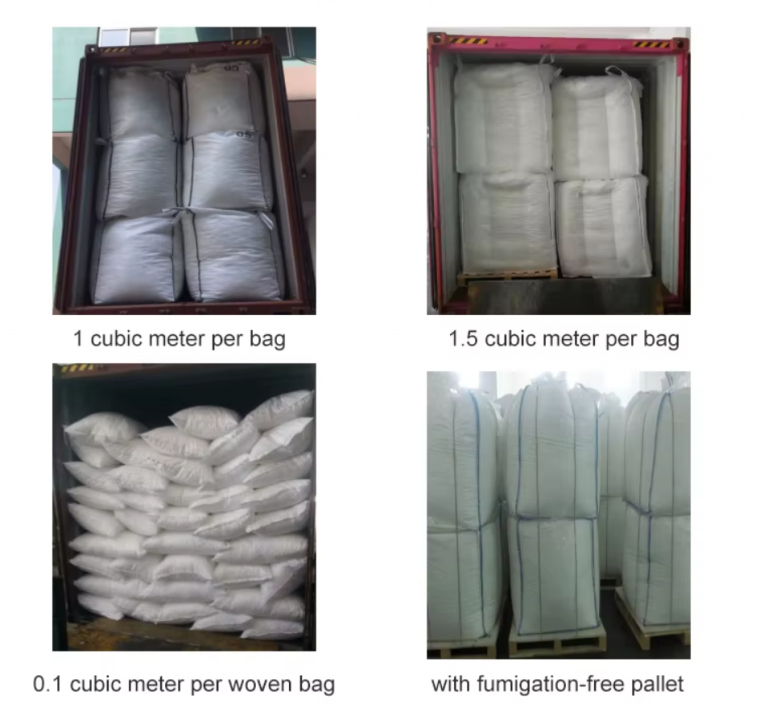
Start with the loading figures, because everything else follows from them. HNS MBBR media is packed at 0.1 m³ per bag, and the container loadings are fixed: a 20ft container takes 30 m³, a 40ft takes 60 m³, and a 40HQ takes 70 m³. If your order is 70 m³, it fills one 40HQ exactly. If your order is 75 m³, it does not fit in one container — you are paying for a second container to carry 5 m³, and your cost per cubic metre jumps.
That is the first question to ask any supplier: how many cubic metres fit in the container for my order, and how close is my quantity to a full container? A supplier who helps you round an order to a full container load is saving you real money. A supplier who quotes a low price per cubic metre and lets you order an awkward quantity is not.
The second question is what the quotation actually includes. EXW, FOB and CIF are not small print — they decide where the supplier’s responsibility ends and yours begins. Under EXW you collect the goods at the factory and arrange everything yourself. Under FOB the supplier delivers to the port and loads the vessel. Under CIF the supplier also arranges the ocean freight and insurance to your port. None of these is “better” in the abstract; what matters is that you know which one you are comparing. Two quotations at the same price per cubic metre are not the same price if one is EXW and the other is CIF.
Ask for the freight term in writing, the port of loading, and the destination port. If the supplier cannot name the port, they have not priced the freight.
MBBR vs Sponge: The Same Container, Seven Times the Media
This is where the comparison between media types gets interesting — and where a per-cubic-metre price comparison without freight is misleading.
MBBR carriers are rigid plastic pieces. They pack the way they pack: 70 m³ in a 40HQ container, and no more. Sponge media is different. HNS NovusPore HPU sponge is vacuum-compressed for shipping, and a 40HQ container loads 500 m³ of it — more than seven times the volume of MBBR carriers in the same box. Once it reaches your site and takes up water, it expands to 1.7 times its compressed volume.
Think about what that means for a buyer. If you need a large volume of media and you are far from the factory, the freight cost per cubic metre of sponge can be a fraction of the freight cost per cubic metre of MBBR — even if the sponge costs more per cubic metre at the factory gate. If your volumes are small, the comparison changes again, and the container maths matters less than the courier or LCL charge.
The point is not that sponge is cheaper than MBBR. The point is that you cannot know which is cheaper delivered until you run the freight calculation for your quantity, your media type, and your port. Any supplier who gives you a per-cubic-metre price and calls it a comparison has skipped the step that decides the answer.
If you are weighing the two media types, start with the product pages — MBBR media and HPU sponge media — and then ask for the delivered cost per cubic metre for each, for your quantity and your port. Compare those two numbers, not the two factory prices.
Small Orders and Samples: Freight Works Differently
Not every order fills a container. Samples, trial quantities and top-up orders travel differently — and the freight rules change with them.
A sample of a few litres goes by courier or air freight, and the freight can cost more than the sample itself. That is normal, and it is worth confirming before the sample ships: who pays the freight, and how much is it? A buyer who has no courier account of their own — as one US operator told us plainly when arranging his samples — needs the supplier to arrange the delivery and quote the freight, not to assume the buyer will handle it. Say so early.
For a small commercial order — a few cubic metres — the choice is usually between LCL (less than container load, sharing a container with other cargo) and air freight. LCL is cheaper per shipment but slower and involves handling at both ends; air freight is fast and expensive, and it only makes sense when the order is urgent or the volume is very small. Ask the supplier which they recommend for your quantity, and what the total delivered cost is under each option. The right answer depends on your deadline, not on the supplier’s preference.
For a full container order, the questions are different: confirm the container type, the loading quantity, and whether the supplier loads and seals the container at the factory or at the port. A sealed container loaded at the factory is one fewer handling step and one fewer chance for short-shipment disputes.
The Hidden Costs: What Else Rides on the Freight Bill
The ocean freight is the biggest line, but it is not the only one. Before you approve a quotation, ask the supplier to confirm — or to tell you plainly that they do not cover — each of these:
- Export documentation and customs at origin. Who prepares the export declaration, and is it included in the price?
- Insurance. Under CIF it is included; under FOB and EXW it is yours to arrange, before the vessel sails.
- Destination charges. Port handling, customs clearance and delivery to your site are almost always the buyer’s cost under FOB and CIF terms. They vary by port, and a supplier who quotes CIF to your port but says nothing about destination charges has not misled you — but you still need to budget for them.
- Packing for the journey. Media bags should be packed to survive a sea voyage: moisture, stacking and handling. Ask how the bags are protected and whether the packing is included in the price or charged separately.
None of these charges is hidden on purpose. They are simply not the supplier’s charges, and buyers who discover them at the destination port are buyers who compared quotations on the wrong number.
How to Compare Two Quotations Fairly
When the quotations are on your desk, run this comparison before you decide:
| Compare | What to check |
|---|---|
| Price basis | EXW, FOB or CIF — same basis, or adjust |
| Quantity vs container | Does the order fill a container? (MBBR: 30 / 60 / 70 m³) |
| Packing | Bag size and count; MBBR 0.1 m³ per bag |
| Freight per m³ delivered | Total delivered cost divided by cubic metres |
| Sample freight | Who pays, and how much, before it ships |
| Destination charges | Who pays port handling and clearance |
| Delivery time | Vessel schedule and port-to-site time |
Worked example, using the loading figures above: suppose you need 70 m³ of MBBR media. That fills one 40HQ container exactly, so your freight is one container, and your freight per cubic metre is the container rate divided by 70. Now suppose you need 75 m³. That is one full container plus 5 m³ in a second container — and your freight per cubic metre rises sharply, because the second container is mostly empty. The fix is simple and costs nothing: ask the supplier what happens if you order 70 m³ now and 5 m³ later, or 140 m³ across two full containers.
The same logic applies to sponge media, with different numbers: 500 m³ per 40HQ when vacuum-packed means most orders fit easily in a single container, and the freight per cubic metre is correspondingly lower. Run the same comparison — total delivered cost divided by cubic metres — and the answer will usually be clear.
What to Send HNS for a Delivered Quotation
If you would like HNS to quote, send us the media type and model (or your reactor volume and wastewater type, and we will suggest one), the quantity in cubic metres, your destination port, and the freight term you prefer — EXW, FOB or CIF. We will reply with the packing and container loading for your quantity, the delivered cost per cubic metre, and the payment and inspection terms, so you can compare our quotation against any other on the same basis.
See the MBBR media range or HPU sponge media for the products, and the MBBR system overview for the full picture. Then contact us — and ask us for the freight maths. We would rather show you the delivered number now than have you discover it later.