
Most questions we receive about plastic bio balls are not really about the ball. They are about the last media the buyer installed.
In November 2026, a wastewater operator in the United States contacted us after the media in his plant degraded within months. His questions were direct: How long will each option honestly last? Is there a PVC version? And which media survives in a unit where changing the media is extremely difficult? This guide answers those questions for one specific product — the modified 50 mm PP bio ball — in the order a buyer should ask them.
First, what “modified” means on this ball
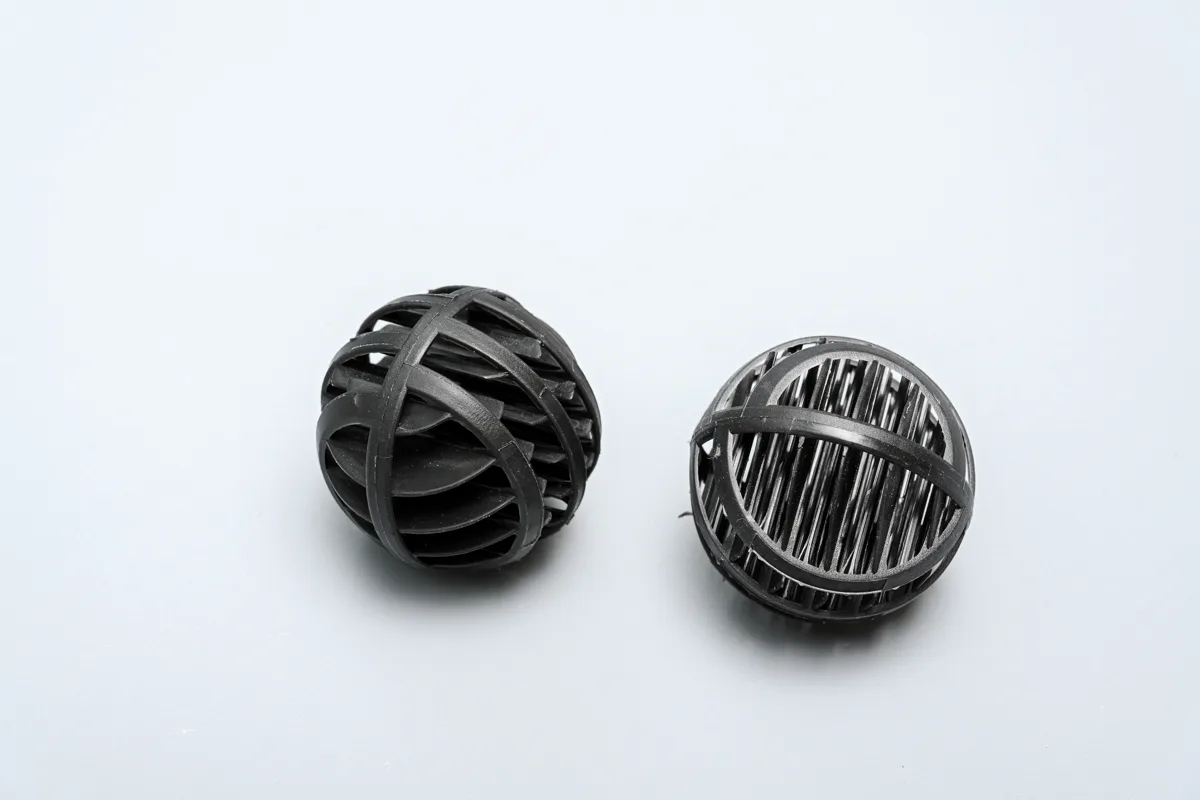
A plain bio ball is a hollow plastic sphere with slots. The modified version is a one-piece polypropylene (PP) ball, 50 mm in diameter, with an internal fin structure that gives the biofilm far more protected surface to grow on than the outer shell alone. It is moulded as a single piece — not two halves snapped together, and not a shell stuffed with sponge.
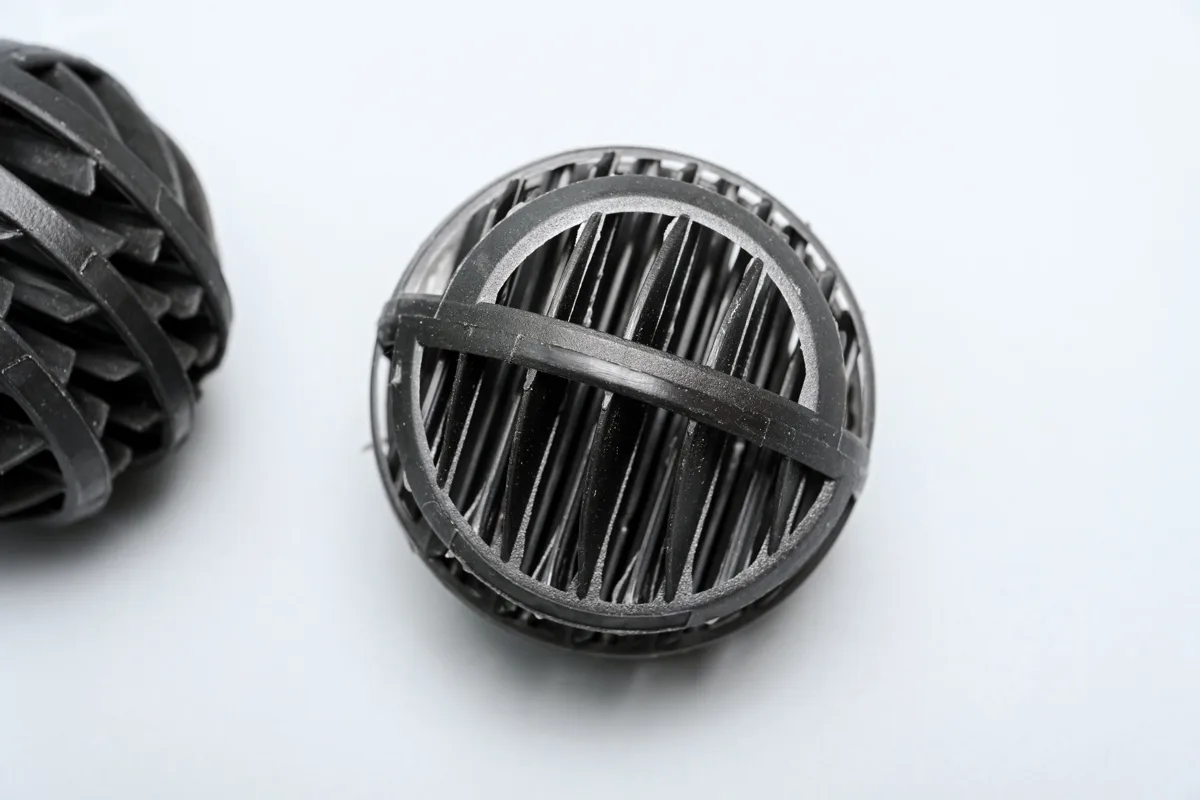
That construction matters for two practical reasons. There is no sponge core to shrink, soften or break down, which is the failure mode behind most “media died in a year” stories. And there are no seams to split open in service.
The supplier of this ball states a specific surface area of 1,400 m²/m³. Treat that number the way you should treat every media supplier’s number, including ours: as a figure quoted on the supplier’s own basis. Surface-area values for ball media are not measured on one universal standard, so a headline number from one factory cannot be compared directly with a headline number from another. What you can compare is construction, material, warranty and the answers you get to the questions below.
Question 1: How long will it actually last?
This is the question that decides most bio ball orders, so here is the honest version.
For this PP ball, the service life we quote is about 5 years in typical use, with a 1-year warranty. That is the figure we are prepared to stand behind in writing. If a supplier — of balls, sponge or any plastic media — promises you 10 to 15 years as a headline claim, ask for that promise in the warranty terms and watch what happens.
For comparison, if you are choosing between this ball and sponge media: hydrophilic PU sponge offers much higher surface area per cubic metre and faster biofilm formation, but its realistic service life in normal use is about 3 years. Neither answer is “better” in the abstract. If your reactor is easy to open and re-fill, sponge’s surface area may be worth a planned replacement cycle. If changing media means draining, confined-space work and days of downtime — as it does for the operator who wrote to us — the longer-lived all-plastic ball is usually the rational buy, even at lower surface area per volume.
One more material note, because buyers ask: this ball is PP, not PVC. For continuously submerged biofilter duty, PP is the standard choice — it is chemically stable in wastewater, light, and does not become brittle the way buyers sometimes fear with lower-grade plastics.
Question 2: Floating or sinking — which version do I need?
The same ball is supplied in two versions:
- Floating version — for aerated tanks and moving or fluidised arrangements where the media should stay suspended in the water column and circulate.
- Sinking version — for fixed beds, trickling and wet/dry biofilters, and chambers where the media must stay where you put it instead of drifting to the surface or the outlet.
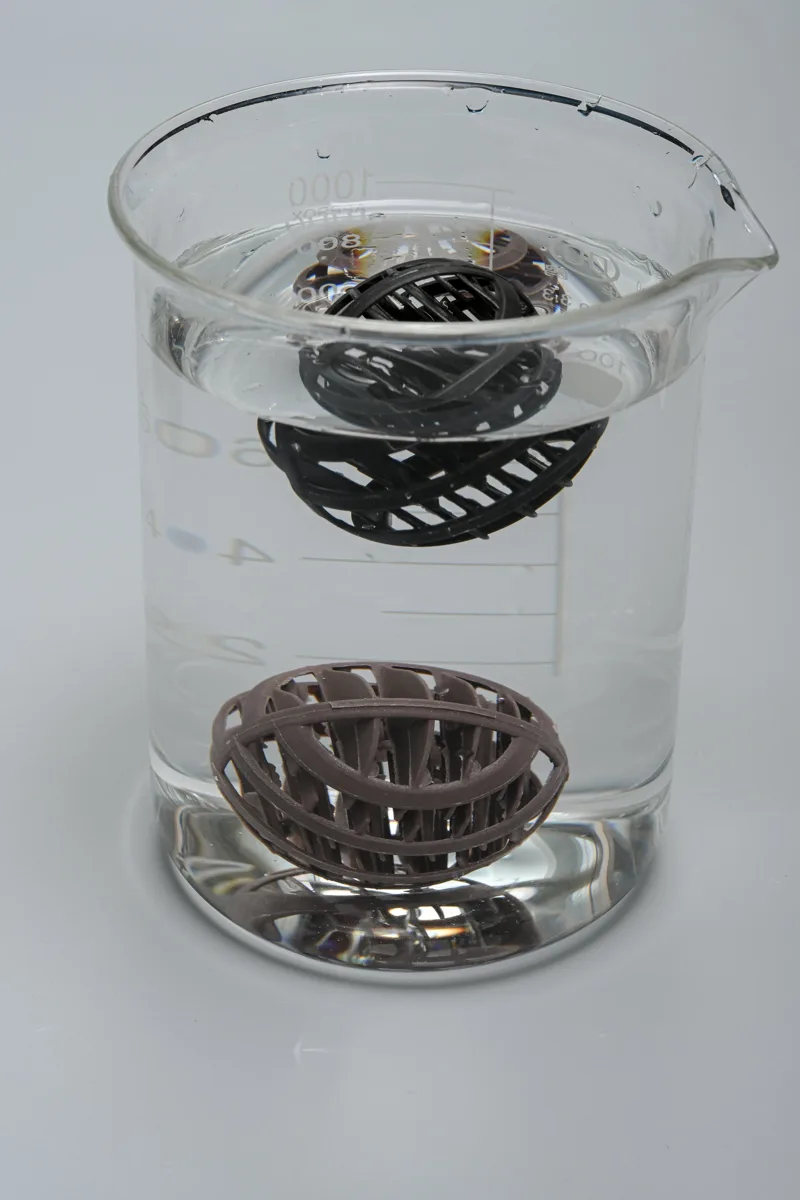
Ordering the wrong version is one of the most common and most avoidable bio ball mistakes: the media is fine, the process data was fine, but the balls collect at the surface (or on the floor) instead of working in the flow. Before you order, tell your supplier how the filter is arranged — fixed bed or moving, aerated or gravity-fed — and let them confirm the version against it. If a supplier quotes you without asking, that is a warning sign.
A scope warning that matters just as much: a 50 mm bio ball is not a drop-in substitute for MBBR carriers in a moving-bed reactor. MBBR media are designed to circulate continuously against retention screens of a matching opening size. Bio balls belong in fixed, trickling and support biofilters — including aquaculture and RAS biofiltration chambers. If your project is a true MBBR, compare purpose-designed MBBR carriers instead; our MBBR system hub explains how the pieces fit together.
Question 3: Will it stay in my reactor?
A ball can only escape through an opening smaller than itself — so check the smallest opening the media can reach: outlet screens, drum or sieve apertures, overflow gaps. Your media diameter must be comfortably larger than that opening.
This sounds obvious until it isn’t. The operator mentioned above runs rotating drums whose openings set a hard minimum media size; loose 50 mm media of any kind would pass straight through, and his only workable routes were large-format media or balls contained inside larger shells. Five minutes spent measuring your screen openings before ordering is worth more than any datasheet.
What to send us for a quotation
You do not need a full design package. For a useful bio ball quotation, send:
- Filter type — fixed bed, trickling/wet-dry, aerated tank, aquaculture/RAS chamber
- Version you believe you need — floating or sinking (or “not sure” — that is a valid answer)
- Available media volume — chamber or tank dimensions
- Smallest screen or outlet opening the media must not pass
- Water basics — flow, and COD/BOD or ammonia load if you have them
- What failed last time, if you are replacing media — this tells us more than any catalogue number
With that, we can confirm the version, estimate the quantity on a stated basis, and quote with the warranty terms in writing. If your application actually calls for sponge media or MBBR carriers instead, we will say so — the NovusPore HPU sponge page shows the other end of the lifespan-versus-surface-area trade-off.
The short version
- One-piece PP, 50 mm, no sponge core and no seams — built against the “media degraded in months” failure.
- Honest life: about 5 years typical, 1-year warranty. Distrust 10–15-year headlines for any media.
- Floating and sinking are different products in practice — confirm the version against your filter arrangement.
- Check your smallest screen opening before you check prices.
- Surface-area claims (this ball’s supplier states 1,400 m²/m³) are quoted on different bases — compare construction and warranty, not just numbers.
Send your filter details via our contact page and we will confirm whether this ball, sponge media or MBBR carriers fit your reactor — with the lifespan figures in writing, not in a headline.
Technical specifications and application notes for this product are on the HydroNovus product page: 50 mm PP Bio Balls for Biological Filtration.