
A typical MBBR process is easy to understand at a high level: wastewater passes through pretreatment, enters one or more biological reactors containing moving biofilm carriers, and then goes through solids separation before discharge or further polishing.
The actual process arrangement, however, depends on what the plant needs to remove. A system designed mainly for BOD reduction may be relatively simple. A plant that must also meet low ammonia or total nitrogen limits may require separate anoxic and aerobic stages, internal nitrate recycle, additional reactor volume, and tighter control of aeration.
The diagram below shows a common MBBR wastewater treatment process and the main equipment involved.
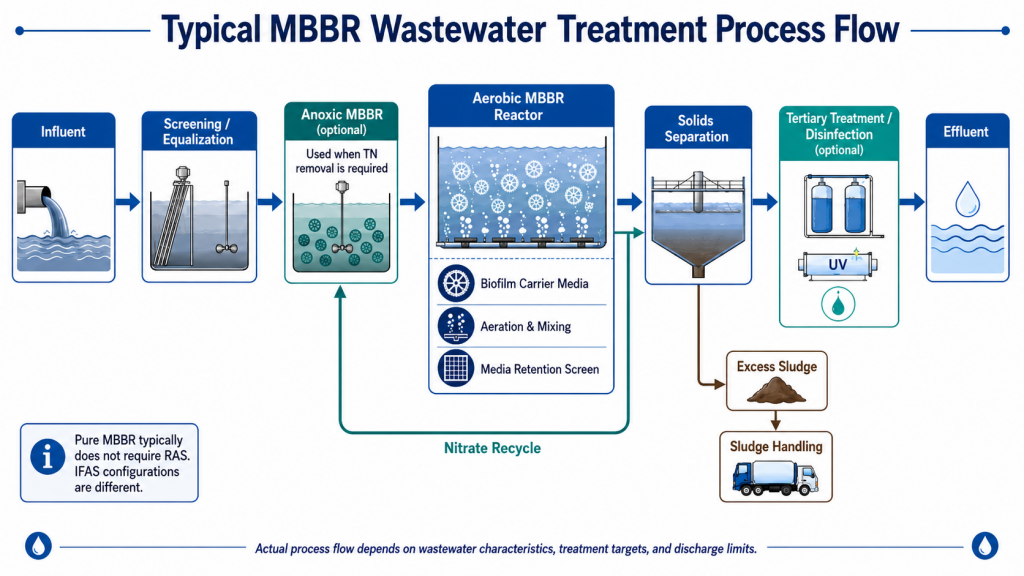
Typical MBBR wastewater treatment process flow. Actual configuration depends on influent characteristics, treatment targets and discharge requirements.
Typical MBBR Process Flow
A practical MBBR treatment train may follow this sequence:
Influent → Screening / Equalization → Anoxic MBBR (when required) → Aerobic MBBR → Solids Separation → Tertiary Treatment / Disinfection → Effluent
If total nitrogen removal is required, nitrified water from the aerobic stage may be recycled to an upstream anoxic zone for denitrification.
This should not be confused with return activated sludge, or RAS. In a pure MBBR, the main biological inventory is retained as biofilm on carrier media inside the reactor. An IFAS system is different because it combines attached biofilm with suspended activated sludge.
How the MBBR Process Works Step by Step
1. Screening and Pretreatment
Wastewater first passes through pretreatment to protect downstream equipment and reduce unwanted solids entering the biological stage.
Depending on the wastewater, pretreatment may include:
- Coarse or fine screening
- Grit removal
- Oil and grease separation
- Equalization
- pH adjustment
- Primary clarification
- Dissolved air flotation for wastewater containing high suspended solids, fats or oils
Not every MBBR plant needs every pretreatment step.
For example, relatively consistent municipal wastewater may require conventional screening and grit removal, while food-processing wastewater can benefit from equalization and removal of fats, oils and suspended solids before biological treatment.
Pretreatment has a direct effect on MBBR stability. Excessive solids, fibers, grease or large debris can interfere with aeration, retention screens and carrier movement.
2. Equalization When Flow or Load Varies
An equalization tank is often useful for industrial wastewater where flow, COD, pH or temperature changes considerably during the day.
Its purpose is not biological treatment itself. Instead, it reduces sudden changes in the load entering the biological reactor.
This can be particularly important for batch-production facilities, food and beverage plants, textile wastewater and other applications where production schedules create large peaks.
A more stable feed generally makes downstream biological treatment easier to control.
3. Anoxic MBBR for Denitrification
An anoxic MBBR stage is used when the process must remove nitrate and achieve a total nitrogen target.
In a common pre-denitrification arrangement, wastewater first enters an anoxic reactor. Nitrified water from the downstream aerobic stage is recycled back to this tank.
Denitrifying bacteria use nitrate as an electron acceptor and convert it ultimately to nitrogen gas under suitable anoxic conditions.
Unlike an aerobic MBBR tank, an anoxic reactor normally relies on mechanical mixing rather than aeration. The objective is to keep the carrier media moving and maintain contact between wastewater and biofilm without introducing excessive dissolved oxygen.
Whether an anoxic stage is required depends on the discharge requirement. A plant designed only for organic removal may not need one.
What Happens Inside the Aerobic MBBR Reactor?
The aerobic reactor is the core biological stage of many MBBR systems.
Three elements are especially important:
Biofilm Carrier Media
MBBR carriers provide protected surface area on which microorganisms can grow as a biofilm.
The carriers move freely through the reactor rather than being fixed in place. Their shape, effective protected surface area, density, filling fraction and hydraulic behavior all influence reactor performance.
Carrier selection should therefore not be based on nominal surface area alone.
The engineering question is how much active carrier surface is required for the expected biological load under the actual wastewater temperature, oxygen level and treatment target.
Aeration and Mixing
In an aerobic MBBR, aeration serves two purposes.
First, it supplies oxygen to the microorganisms responsible for removing organic matter and, where required, nitrifying ammonia.
Second, it provides mixing energy that keeps the carriers moving throughout the tank.
This makes aeration design especially important. A system can have enough carrier media on paper but still perform poorly if oxygen transfer or media movement is inadequate.
Air distribution should avoid stagnant zones, media accumulation and areas where carriers do not circulate effectively.
For this reason, carrier filling fraction, reactor geometry and diffuser arrangement should be considered together rather than selected independently.
Media Retention Screen
The carrier media must remain inside the biological reactor while treated water is allowed to pass downstream.
A media retention screen is therefore installed at the reactor outlet.
The screen opening, hydraulic loading and available open area must be compatible with the selected carrier.
An undersized retention screen can create excessive head loss or local hydraulic problems. Poor screen positioning can also contribute to carrier accumulation near the outlet.
The retention system is a small part of the equipment list, but it is an important part of reliable MBBR operation.
MBBR for BOD Removal, Nitrification and Total Nitrogen Removal
There is no single MBBR process flow that fits every project.
The treatment objective determines the biological configuration.
MBBR for BOD and COD Reduction
For wastewater where the main target is biodegradable organic matter, a relatively simple arrangement may be sufficient:
Pretreatment → Aerobic MBBR → Solids Separation → Effluent
Heterotrophic microorganisms growing on the carrier biofilm consume biodegradable organic compounds.
The required reactor volume and carrier quantity depend on factors such as organic loading, wastewater temperature, biodegradability and the required effluent quality.
MBBR for Ammonia Nitrification
When ammonia removal is required, the system must provide conditions that support nitrifying bacteria.
Important design factors include:
- Influent ammonia load
- Wastewater temperature
- Dissolved oxygen
- Alkalinity and pH
- Available carrier surface area
- Organic loading entering the nitrification stage
- Required effluent ammonia concentration
Nitrification should therefore not be specified simply as a fixed percentage removal.
A system treating warm wastewater to a moderate ammonia limit may require a very different design from one expected to nitrify cold wastewater to a low final ammonia concentration.
MBBR for Total Nitrogen Removal
Nitrification converts ammonia nitrogen to nitrate, but it does not by itself remove total nitrogen from the water.
When a low total nitrogen limit must be met, denitrification is normally required as well.
One common arrangement is:
Anoxic MBBR → Aerobic MBBR → Solids Separation
with an internal nitrate recycle from the aerobic stage to the anoxic stage.
The recycle rate should be determined from the nitrogen balance and process design rather than selected as a universal percentage.
Carbon availability is another important consideration. Depending on the wastewater and target, the influent may provide sufficient readily biodegradable carbon, or an external carbon source may need to be evaluated.
Does a Pure MBBR Need Return Activated Sludge?
Normally, a pure MBBR does not rely on return activated sludge to maintain the main biological population.
This is one of the important differences between MBBR and conventional activated sludge.
In a pure MBBR, microorganisms grow primarily as attached biofilm on carriers retained inside the reactor. Biofilm continuously grows, ages and sheds excess solids, but the carriers themselves stay in the biological tank.
The sloughed solids leave with the treated water and are removed downstream.
This is different from IFAS — Integrated Fixed-Film Activated Sludge.
An IFAS system intentionally maintains both:
- Attached biomass on carrier media
- Suspended activated sludge in the mixed liquor
Because suspended activated sludge is part of the IFAS process, sludge return can be required.
This distinction is important when reading or drawing a process flow diagram. A recycle line labeled nitrate recycle is not the same as a RAS line.
Why Solids Separation Is Still Needed After an MBBR
Even though a pure MBBR does not normally require RAS to maintain biomass, it still produces suspended solids.
Biofilm grows on the carrier and naturally sheds as part of normal biological renewal. Influent suspended solids may also pass through the biological stages.
These solids normally need to be separated before final discharge or reuse.
Depending on the project, downstream separation may use:
- Secondary clarification
- Lamella clarification
- Dissolved air flotation
- Media filtration
- Cloth or disc filtration
- Other polishing processes
The best option depends on solids characteristics, hydraulic loading, footprint, final TSS requirement and the overall treatment train.
A conventional clarifier may be appropriate for one application, while DAF or additional filtration may be more suitable for another.
Sludge Handling After the MBBR Process
Separated biological solids eventually become excess sludge that must be handled.
A typical sludge line may include:
Sludge collection → Thickening or conditioning → Dewatering → Disposal or further treatment
The exact equipment depends on sludge quantity, solids concentration, disposal route and required cake dryness.
For plants seeking compact continuous sludge treatment, screw-type dewatering systems can be considered alongside centrifuges, belt presses and other dewatering technologies.
Sludge handling should be included when evaluating the complete MBBR system. It is easy to focus on the biological reactor and overlook the downstream equipment needed to manage the solids the process produces.
When Is Tertiary Treatment Required?
An MBBR is a biological treatment process. It does not automatically guarantee that every final discharge or reuse limit will be met without additional treatment.
Tertiary treatment may be required when the project has strict limits for:
- Suspended solids
- Phosphorus
- Pathogens
- Turbidity
- Residual COD
- Color
- Reuse water quality
Possible downstream processes include filtration, chemical phosphorus removal, activated carbon, membranes, UV disinfection, chlorination, ozonation or other polishing steps.
The biological process should therefore be designed as part of the complete treatment train rather than as an isolated reactor.
How the MBBR Process Changes for Different Wastewaters
Municipal Wastewater
Municipal applications commonly focus on BOD removal, ammonia nitrification and, where required, nitrogen removal.
The process may include anoxic and aerobic stages followed by solids separation and disinfection.
Retrofit projects can also use carrier media to add attached biomass to existing biological tanks when additional treatment capacity is required.
Food and Beverage Wastewater
Food-processing wastewater can have high and variable organic loads and may also contain fats, oils and suspended solids.
Equalization and physical-chemical pretreatment can therefore be important before the biological stage.
The best process should be selected after reviewing wastewater variability rather than using average COD alone.
Textile and Industrial Wastewater
Industrial wastewater may contain compounds that are poorly biodegradable or inhibitory to biological treatment.
For these applications, treatability, pH, temperature, salinity and wastewater composition should be reviewed carefully.
MBBR may form one part of a larger process that includes chemical pretreatment, oxidation, clarification or tertiary treatment.
Existing Wastewater Plant Upgrades
MBBR is also considered when an existing plant needs more biological capacity but available tank volume or land is limited.
Before adding carrier media to an existing tank, the retrofit should confirm:
- Available reactor volume
- Existing aeration capacity
- Hydraulic profile
- Tank geometry
- Retention-screen installation
- Downstream solids-separation capacity
- Required treatment improvement
Simply adding more media does not automatically increase plant capacity if oxygen transfer, mixing or downstream equipment becomes the limiting factor.
MBBR Media Quantity Is Not the Same as Reactor Volume
One common mistake during early project discussions is to calculate MBBR media only as a fixed percentage of tank volume.
Filling fraction is important, but it is not the starting point for a reliable biological design.
The required media volume should be related to the biological load and the effective carrier surface needed for the target process.
The design should then confirm whether the selected quantity can be properly mixed and retained in the available tank.
Factors normally reviewed include:
- Average and peak flow
- BOD and COD
- Ammonia nitrogen
- Total nitrogen
- TSS
- Wastewater temperature
- pH and alkalinity
- Required effluent quality
- Carrier characteristics
- Available reactor volume
- Aeration and mixing capacity
For a broader discussion of capital cost, media quantity and equipment scope, see our guide How Much Does an MBBR System Cost? Pricing Factors and Budget Guide.
Key MBBR Design Checks Before Equipment Selection
Before selecting media, blowers, diffusers or tanks, it is useful to confirm several basic design questions.
What is the actual treatment target?
“Wastewater treatment” is not a design target.
The process changes depending on whether the project needs only BOD reduction, ammonia nitrification, total nitrogen removal, phosphorus control or reuse-quality effluent.
What are the average and peak loads?
Flow alone is not sufficient.
Two plants with the same flow can require very different biological systems if their BOD, COD or ammonia concentrations are different.
Is the wastewater consistent?
Average laboratory data may hide production peaks.
Industrial projects should identify changes between shifts, production lines, cleaning cycles and seasonal operating conditions.
Is there enough oxygen-transfer and mixing capacity?
Aeration must satisfy both biological oxygen demand and carrier movement requirements in an aerobic reactor.
This becomes particularly important in retrofit projects.
How will the carriers be retained?
Retention-screen design should be addressed during initial layout work rather than added after the biological tank has already been finalized.
How will biological solids be removed?
Clarification, flotation or filtration capacity should be checked together with the MBBR reactor.
The biological stage cannot compensate for an undersized downstream separation process.
What Information Should Be Sent for an Initial MBBR Process Review?
For a preliminary review, the most useful information is:
- Wastewater source and industry
- Average flow
- Peak flow
- Operating hours per day
- BOD
- COD
- TSS
- Ammonia nitrogen
- Total nitrogen, where relevant
- pH
- Temperature
- Existing treatment process
- Existing tank dimensions, for retrofit projects
- Required effluent or reuse standard
- Available installation space
- Any known operational problems
Laboratory reports, process drawings and existing plant photographs are also useful when available.
At the preliminary stage, incomplete data can still be reviewed. The important point is to separate confirmed information from assumptions that need further testing or verification.
How HNS Watertech Supports an MBBR Project
HNS Watertech supplies biological carrier media and supporting wastewater-treatment equipment for new MBBR installations and plant upgrades.
Depending on the project scope, equipment review may include:
- MBBR biofilm carrier media
- Aeration diffusers and related aeration components
- Media retention components
- Screening equipment
- Dissolved air flotation
- Chemical dosing
- Sludge dewatering equipment
- Supporting process equipment
For MBBR media selection, we review the application rather than recommending a model only from a surface-area number.
For retrofit work, existing tank dimensions, aeration capacity and the required improvement are especially important because the carrier is only one part of the complete system.
MBBR Process Flow FAQ
What is the basic MBBR process flow?
A basic process for organic removal may be:
Pretreatment → Aerobic MBBR → Solids Separation → Discharge
If nitrogen removal is required, an anoxic stage and nitrate recycle may be added.
The final arrangement depends on wastewater characteristics and effluent requirements.
What is the purpose of MBBR carrier media?
Carrier media provide protected surface on which microorganisms grow as biofilm.
The carriers move through the reactor and allow a substantial attached microbial population to remain within the biological stage without relying on conventional sludge return to retain that biomass.
Does an MBBR require aeration?
An aerobic MBBR requires aeration for oxygen transfer and carrier mixing.
An anoxic MBBR normally uses mechanical mixing because excessive oxygen would interfere with denitrification.
Does MBBR require a secondary clarifier?
MBBR produces suspended biological solids that normally require downstream separation.
A secondary clarifier is one option, but depending on the application, lamella clarification, DAF or additional filtration may be used instead.
Does MBBR need RAS?
A pure MBBR normally does not depend on return activated sludge to maintain its attached biomass.
IFAS is different because it combines carrier biofilm with suspended activated sludge and may use RAS.
What is nitrate recycle in an MBBR system?
When pre-denitrification is used, nitrate-rich water from the nitrifying aerobic stage is recycled to the upstream anoxic stage.
This is an internal process recycle for nitrogen removal and should not be confused with return activated sludge.
How much MBBR media should be added to a tank?
There is no universal media percentage that is correct for every project.
Media quantity should be determined from the biological load, carrier characteristics, treatment target, temperature and available reactor conditions, followed by a check of mixing, aeration and retention requirements.
Can an existing aeration tank be converted to MBBR?
Often it can be evaluated for retrofit, but the existing tank should first be checked for volume, geometry, aeration capacity, hydraulic conditions, media-retention installation and downstream solids separation.
Adding carriers without checking these constraints can simply move the bottleneck elsewhere in the plant.
Can MBBR remove total nitrogen?
MBBR can be configured for nitrification and denitrification, but aerobic nitrification alone does not remove total nitrogen.
Low TN targets generally require an appropriate anoxic/denitrification stage and process recycle, with carbon availability considered in the design.
Can MBBR remove phosphorus?
MBBR by itself should not be assumed to meet a stringent phosphorus limit.
Depending on the target, phosphorus removal may require chemical precipitation, an integrated biological nutrient-removal process or another dedicated treatment step.
Request an MBBR Process Review
If you are planning a new MBBR system or upgrading an existing biological treatment plant, send us the available project data before selecting media or equipment.
For an initial review, provide the average and peak flow, influent analysis, treatment target, operating hours, existing tank information and expected equipment scope.
We can then identify which information is sufficient for preliminary equipment selection, which assumptions still need confirmation, and what additional data may be required.
Technical References
- di Biase A, et al. Moving bed biofilm reactor technology in municipal wastewater treatment: A review. Journal of Environmental Management. 2019;247:849–866. DOI: 10.1016/j.jenvman.2019.06.053.
- Ngo HH, et al. Moving bed biofilm reactor for wastewater treatment. In: Advances in Biological Wastewater Treatment Systems. 2022;119–153. DOI: 10.1016/B978-0-323-99874-1.00019-1.
- Mahto KU, Das S. Bacterial biofilm and extracellular polymeric substances in the moving bed biofilm reactor for wastewater treatment: A review. Bioresource Technology. 2022;345:126476. DOI: 10.1016/j.biortech.2021.126476.