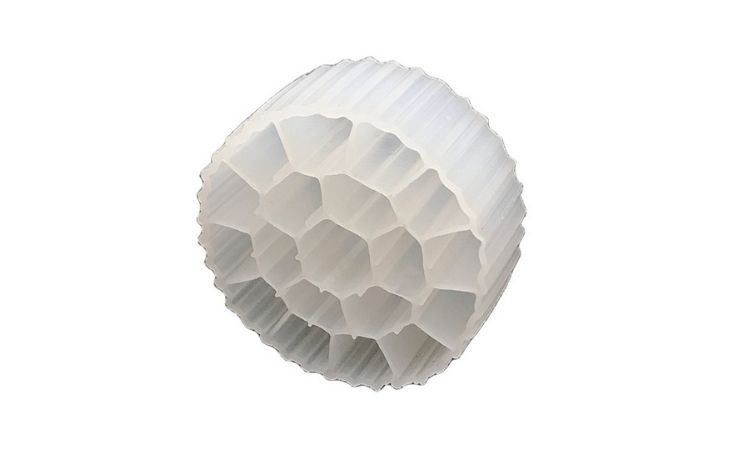
Every MBBR media supplier’s website says the same things: high surface area, virgin material, long service life, best price. The quotations in your inbox look similar too — until the media arrives, and the differences show up in your reactor.
A bad media choice is not a small mistake. Media that sinks when it should float, cracks within a year, or carries a fraction of the surface area on its data sheet will cost you far more than the price difference you saved. Vetting the supplier before you order is the cheapest insurance in the whole project.
These eight questions separate a supplier who can stand behind their media from one who is reselling a catalogue photo. Ask them all, in writing, before you pay anything.
1. Are You the Factory — and for Which Product?
The first question is not rude; it is the most important one. In this industry, “manufacturer” can mean three different things: the company that owns the extrusion lines, a trading company with a factory agreement, or a reseller who buys from whoever is cheapest this month. If something goes wrong with a batch, only the party that controls production can remake it.
Ask the supplier to state plainly whether they manufacture the exact product you are buying or source it. At HNS Watertech, MBBR carriers and sponge media are produced at our own factory in Yixing, and the equipment we supply — DAF systems, screw presses, clarifiers and aeration equipment — is manufactured in our own factory as well. A supplier who cannot answer that clearly is telling you something.
2. Is It 100% Virgin HDPE — and How Do You Prove It?
This is the single biggest quality divide in MBBR media, and the hardest to judge from a photo. Recycled HDPE can look identical on arrival and behave very differently in service: it is more brittle, it absorbs water unevenly, and it is the usual suspect when media cracks, sinks, or sheds fragments after a season.
A serious supplier should be able to give you numbers, not adjectives. For HNS MBBR media, the specification is 100% white virgin HDPE with a density of 0.96–0.98 — density is what keeps the carrier near neutral buoyancy in the reactor. Ask your supplier for the material grade and density of the exact model you are buying, in writing, on the quotation or data sheet.
Then ask what happens if the delivered media does not match that specification: is there a pre-shipment inspection or a replacement commitment? A supplier confident in virgin material will welcome the question.
3. Show Me the Data Sheet for the Exact Model
“High surface area” is not a specification. A data sheet is. Before you compare two quotations, make sure you are comparing the same thing: the same model, with its own stated surface area, dimensions, density and dosing range.
HNS publishes its MBBR range by model: MBBR19 above 650 m²/m³, MBBR37 above 800, MBBR64 above 1,200, MBBR76 above 1,600 m²/m³, with other models from above 800 to above 1,000 m²/m³. A quotation that quotes a surface area without naming the model is quoting nothing.
Three things to check on any data sheet you receive:
- Does the surface area match the model? Ask the supplier to confirm the figure in writing for the model on your quotation. If two suppliers quote the same-looking carrier with wildly different surface areas, one of them is guessing.
- Is there a measurement basis? You do not need a laboratory report to buy media, but you should know whether the figure is measured, calculated, or a catalogue estimate.
- Does the rest of the sheet agree with itself? Density, dimensions and packing should be consistent. A data sheet that contradicts its own quotation is a warning sign, not a typo to ignore.
For the technical background on comparing surface area between models, see Hydronovus: MBBR media selection by surface area.
4. What Dosing Range and Start-Up Behaviour Should I Expect?
A quotation tells you the price per cubic metre. It does not tell you whether the media will actually work in your tank — that depends on how much of it you use and how quickly biofilm establishes on it.
Ask the supplier to state the recommended filling ratio and the expected film-formation time for their media. For HNS MBBR media, the dosing range is 15–65% of the reactor volume and the membrane-forming period is 3–15 days, depending on the wastewater and the model. Those are not performance guarantees — no honest supplier guarantees biology on a fixed timetable — but they are the numbers your design depends on, and they should appear in the supplier’s reply. A supplier who cannot discuss filling ratio, or who promises the same start-up time for every wastewater, has not earned your order.
5. What Does the Packing and Loading Look Like?
Media is bought by the cubic metre and shipped by the container, and the gap between the two is where budgets quietly break. Ask for the packing specification and the container loading for your quantity before you approve a quotation.
HNS MBBR media is packed at 0.1 m³ per bag, and a 40HQ container loads 70 m³; a 40ft loads 60 m³ and a 20ft loads 30 m³. That is the arithmetic your landed cost depends on: if a supplier quotes a low price per cubic metre but packs loosely, you pay for the extra containers. Sponge media is a different case again — vacuum-compressed, it loads far more per container — which is why a per-cubic-metre price comparison between MBBR and sponge without the freight math is meaningless.
Ask for: bag size and weight, bags per container for your order, and whether the quotation is EXW, FOB or CIF — and to which port.
6. Can I Test a Sample First — and What Will It Prove?
A sample is the cheapest test in the whole purchase, and the most misused. A sample can prove material, dimensions, workmanship and packing. It cannot prove how the media will perform in your wastewater over five years — and any supplier who says it can is overselling.
Ask the supplier: what sample sizes are available, how quickly they ship, what they cost, and whether the sample is cut from production stock or made specially. Then check the sample yourself when it arrives — material, dimensions, workmanship and packing are all things you can judge in your hands before you commit to a container. A supplier who sends a sample quickly, from real stock, with a data sheet attached, is showing you their normal product.
7. What Are the Payment, Inspection and Warranty Terms — in Writing?
Price is one line on a quotation. The terms around it decide how much risk you carry. Before you pay, get these in writing:
- Payment terms. What share is paid upfront, what share on shipment, and against which documents? Be cautious of any supplier who demands full payment before production with no inspection step.
- Inspection. Can you inspect before shipment, or appoint a third-party inspector? What happens if the inspection fails — remake, replacement, or refund?
- Warranty. What exactly is warranted, for how long, and what does the supplier do if media fails within the period? Media life and warranty length are not the same number: HNS MBBR media has a service life above 15 years, but the warranty terms on any order are a separate commercial agreement and should be stated on the quotation itself.
- Claims process. If a container arrives short or damaged, who do you call? Get a name, not a generic inbox.
8. Who Answers After the Order Ships?
The sale ends at the port. Your project does not. Ask who your contact is after shipment: the same person who quoted you, or a handover to someone you have never spoken to? What happens if you need a top-up order of the same model in six months — is it still in production, and at what minimum quantity? And if you need a matching component later, such as retention screens or aeration parts, can the same supplier provide them?
Quick Vetting Checklist
| Check | What good looks like |
|---|---|
| Factory status | States plainly what it makes vs sources |
| Material | 100% virgin HDPE, density stated (e.g. 0.96–0.98) |
| Data sheet | Model-specific surface area, in writing |
| Start-up data | Dosing range and film-formation time stated |
| Packing | Bag size, container loading, Incoterms stated |
| Sample | Available from stock, with data sheet |
| Terms | Payment, inspection, warranty in writing |
| After-sales | Named contact, repeat orders, spares |
If a supplier passes all eight, you have found a partner. If one fails three or more, keep looking.
What to Send HNS for a Quotation
If you would like HNS to quote, send us the model you are considering (or your reactor volume and wastewater type, and we will suggest one), the quantity in cubic metres, your destination port, and whether you want a sample first. We will reply with a model-specific data sheet, packing and container loading, payment and inspection terms, and a named contact who stays with the order from quotation to delivery.
Start with our MBBR media range or the MBBR system overview to see the models, or read about HPU sponge media if you are comparing sponge against plastic carriers. Then contact us — and bring your eight questions.