A process engineer asked us a simple question: send me the design data for your sponge media. Not the brochure. The numbers she could put into a design.
She asked twice, a week apart. When a designer is working on a real project and the media is the pressing item, a glossy product page does not help. She needs the handful of numbers that decide tank volume, fill rate, and order quantity — and she needs to know which datasheet numbers are real and which are decoration.
This article is for that reader. If you are designing with sponge biofilm media, or checking a supplier’s datasheet before you specify it, here is what actually matters, what to ask for, and what to send us when you want a quotation.
The buying problem: every datasheet looks complete, and most are not
Sponge datasheets tend to list the same things: a surface area figure, a porosity figure, a cube size, and a claim about fast startup. Side by side, the numbers look comparable — but the same word can mean different things.
Surface area is the classic example. One supplier quotes a theoretical figure. Another quotes a BET-measured protected surface area. Those two numbers can sit in the same table and describe very different things — and a designer who takes the bigger one at face value can end up with an undersized tank.
The fix is not to collect more numbers. It is to know which five or six numbers drive the design, and to ask each supplier for those numbers measured the same way.
What actually decides it: six numbers, in the order a designer uses them
1. Protected surface area — the number the load calculation rests on
For NovusPore, protected surface area is above 5,000 m²/m³ by BET — the figure a loading calculation rests on: daily pollutant load divided by total protected surface area in the tank.
Ask three things about this number: is it BET-measured or theoretical? Is it protected surface — the pore area where biofilm grows — or total surface including faces that see no flow? Does it hold across the cube sizes offered, or change with size? If a supplier cannot answer, treat the headline number with caution and ask for the test basis in writing.
2. Porosity — why sponge carries so much more biofilm than plastic
NovusPore porosity is above 98%. That is the structural reason sponge media holds far more biomass per cubic metre than a plastic carrier: almost the whole cube is open pore space, and the biofilm grows through the volume, not only on an outer skin.
In practice, porosity is what lets a sponge retrofit raise capacity without a new tank. It also means sponge compresses and plastic does not, which changes freight and handling.
3. Wet expansion — the number that catches out first-time buyers
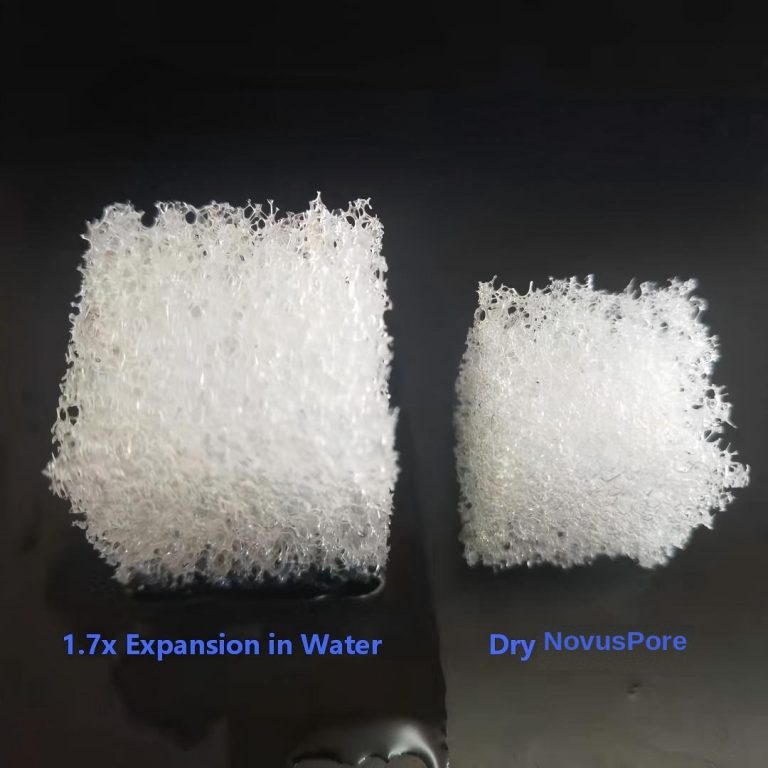
Dry sponge cubes are small. Wet, they expand to about 1.7 times their dry volume. This is the single most common source of ordering mistakes we see with sponge media.
Size the order on dry volume and you will under-order by a large margin; check the delivery against dry volume and you will think the shipment is short. The order, the tank fill, and the receiving check all have to be done on the wet, working volume. Ask the supplier to state the expansion factor and quote on wet volume, and check deliveries by cube or bag count, not dry-box volume.
4. Fill rate — the operating window, not a single figure
A sponge MBBR does not run at one fixed fill rate. The working range for HNS media is 15–65% of tank volume, depending on load, aeration, and how much room the design leaves for the media to move. A designer needs the range, not a single percentage — and if a supplier quotes one fill rate with no range and no conditions, ask what load and temperature it assumes. A fill rate without its assumptions is not a design input.
5. Biofilm establishment time — what “fast startup” really means
NovusPore typically establishes biofilm in 3–7 days — fast against plastic carriers, and a real reason to choose sponge for a retrofit or a plant that cannot afford a long startup.
But treat the range honestly. Three to seven days is typical under normal conditions, not a guarantee for every wastewater — temperature, influent strength, and seeding all move the number. The useful question is not “how fast” in the abstract, but what the startup sequence looks like: when to start feeding, when to check the biofilm, and what to measure. Ask for that sequence, not just the day count.
6. Top-up horizon — the number nobody puts on the datasheet
Sponge media wears. Over time, cubes shrink and lose material, and the fill rate in the tank falls. For NovusPore, a top-up is typically needed after about five years of stable operation in normal wastewater duty — longer where the water is gentle, sooner in a hard rotating-drum duty, where about three years is the working figure.
That is a planning horizon, not a warranty: budget for a top-up order around year five, and leave access and a spare-media allowance in the plan. A supplier who will not discuss wear is not giving you the full cost of ownership.
| Datasheet number | What it decides | What to check before you trust it |
|---|---|---|
| Protected surface area (>5,000 m²/m³, BET) | Tank volume and media volume for the load | BET-measured? Protected, not total? Same across cube sizes? |
| Porosity (>98%) | Biomass per cubic metre; retrofit capacity gain | Measured how? Consistent across batches? |
| Wet expansion (about 1.7×) | Order quantity and receiving check | Quoted on wet volume? Expansion stated on the datasheet? |
| Fill rate (15–65% range) | Operating window and aeration demand | Range with assumptions, or one unexplained figure? |
| Biofilm establishment (3–7 days typical) | Startup schedule | Sequence described, or only a day count? |
| Top-up horizon (about 5 years of stable use in normal duty; about 3 years in harsh rotating-drum duty) | Lifetime cost and spares planning | Discussed openly, or avoided? |
What not to ask: the numbers that look technical and decide nothing
Two requests waste everyone’s time. The first is asking for foam density as a proxy for firmness. Density does not equal firmness, and firmness does not equal performance. Specify the six numbers above instead.
The second is asking for a guaranteed service life. No supplier can guarantee a life in years for a biological product that lives in real wastewater. What a good supplier can give you is the top-up horizon, the wear behaviour, and the conditions the figure assumes. That is honest, and it is enough to plan on.
The datasheet checklist: send this to your supplier
Before you specify sponge media on a project, ask the supplier for the following in writing:
- Protected surface area, BET-measured, with the test basis stated
- Porosity, with the measurement method stated
- Wet expansion factor, and confirmation that quotations are on wet volume
- Cube sizes available, and whether surface area changes with size
- Fill rate range with the load and temperature assumptions behind it
- Biofilm establishment window and the startup sequence to follow
- Top-up horizon and what wear looks like in practice
- Material basis — for HNS NovusPore, hydrophilic polyurethane sponge — and whether the product is supplied as loose cubes, in bags, or pre-packed
- Freight format: compressed volume per container, because sponge ships vacuum-compressed and the freight cost per cubic metre of working volume is far lower than for plastic media
If a supplier answers all nine, you have a datasheet you can design from. If a supplier answers three and waves at the rest, you have a brochure.
The selection logic against plastic carriers is covered on our technical site: HPU sponge vs HDPE MBBR carriers — how to choose. This article is the checklist you send to a supplier.
What to send HNS for a quotation
When you are ready for numbers, send us the same project data you would send any MBBR supplier. Our MBBR quotation checklist lists the five numbers that decide the price:
- Flow and load: daily flow, influent and target effluent concentrations, and the pollutant that governs the design
- Tank data: volume, dimensions, and water depth, or the space available for a new tank
- Operating conditions: temperature range and anything unusual in the wastewater
- The design question itself: are you sizing a new tank, retrofitting an existing one, or topping up media that is already in service?
If you already have a loading calculation, send it; if not, send the project data and we will work from the same six numbers. We manufacture the media at our own factory in Yixing, and supply the full range — sponge, MBBR carriers, aeration, and components — so one quotation can cover the media and the parts around it.
More on the product: NovusPore sponge media. More on the systems: MBBR system.
The decision
A good sponge media datasheet is short: six numbers, each with its test basis and assumptions, plus wet volume and a top-up horizon. Everything else is marketing. If the supplier can give you those six numbers in writing, you can design with confidence. If they cannot, the cheapest quotation on the table is the one that leaves you guessing at the tank size.
Send your project data and datasheet questions via our contact page — we will answer with numbers, not a brochure.