A dissolved air flotation (DAF) unit rarely fails because the tank is the wrong size. More often it fails because the chemical dose is wrong on the day the water changes — and nobody notices until the effluent goes cloudy. The dosing control you order decides how often that happens, and what it costs.
This is a procurement decision, not an operations detail: changing from manual to automatic dosing after the DAF is built means new pumps, instruments, wiring and a control panel. Decide before you order — it costs nothing; decide after start-up and it costs a retrofit.
What dosing control actually does
A DAF separates solids by attaching tiny air bubbles to flocs and floating them to the surface. The coagulant — usually PAC, ferric or alum — creates those flocs; with no coagulant, or the wrong dose, the bubbles have nothing to lift.
The correct dose is not a catalogue number: jar testing on your actual wastewater sets it, and it moves with flow rate, solids load, oil and grease, pH and temperature. Dosing control is the system that delivers that moving dose, day after day. Manual control means an operator sets the pump and adjusts it by judgement. Automatic control means the system adjusts the pump itself, following flow or a water-quality signal. Both treat the same water; they differ in who notices the change first — a person, or an instrument.
Manual dosing: when it works, and what it costs
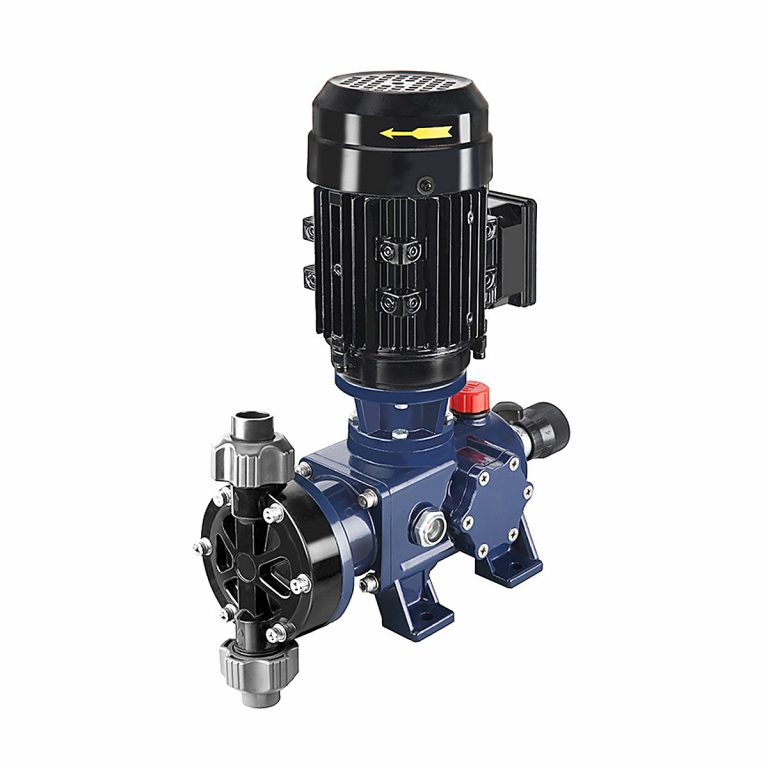
Manual dosing is a dosing pump set by hand: the operator reads the flow, checks the water, and turns the pump up or down. It is the cheapest to buy, the simplest to understand and the easiest to repair — almost nothing to calibrate, nothing to program.
It works well when flow and load are genuinely steady — one line, one product, one shift pattern — when a trained operator is present whenever the plant runs, and when the discharge limit has enough margin that a few hours of imperfect dosing cause no compliance problem.
The cost of manual dosing is paid in attention: somebody must adjust the pump at every load change — a changeover, a cleaning cycle, a rainstorm, a Monday start-up. If the operator is busy or absent, the dose stays put while the water moves on: overdosing wastes chemical and makes extra sludge, underdosing sends solids through to the effluent and whatever follows the DAF.
Manual dosing also hides its cost: chemical use is rarely metered against flow, so a slow upward drift goes unnoticed for months. Ask the supplier to state the expected consumption range in writing.
Automatic dosing: what you are really buying
Automatic dosing puts the operator’s judgement into a control loop: flow-paced dosing, where the pump rate follows incoming flow, and feedback dosing, where a signal from the water — turbidity, streaming current or pH — trims the dose. Most real systems combine the two — flow pacing sets the base dose, feedback corrects it.
Automatic control earns its price when the water refuses to sit still — variable production, batch discharges, cleaning cycles, seasonal change, an unmanned night shift — and when the discharge limit is tight, or the DAF protects a biological stage downstream: an MBBR plant does not forgive a slug of unsettled solids or a chemical overdose the way a drain does.
But automatic does not mean fit-and-forget: it means instruments needing calibration, cleaning and replacement. A turbidity probe fouls; a flow meter drifts; a pH electrode ages. The system is only as honest as its dirtiest sensor, and a plant that cannot maintain instruments will get worse results from automation than from a careful operator with a manual pump. Before paying for it, ask who calibrates the sensors, how often, and what the plant does when one fails — a system pumping blindly on a dead signal is worse than a manual one.
Ask about the middle option too: flow-paced dosing without feedback costs less than a full feedback loop, has no probe to foul, and still tracks the biggest driver of dose — how much water is arriving.
The decision, side by side
| Factor | Manual dosing | Automatic dosing |
|---|---|---|
| Purchase cost | Lowest | Higher — pumps, instruments, panel, programming |
| Best when flow and load are | Steady and predictable | Variable, batch or seasonal |
| Operator presence needed | Whenever the plant runs | For checks and calibration only |
| Response to a sudden load change | As fast as the operator notices | Minutes, if set up correctly |
| Main failure mode | Dose left unchanged while water changes | Fouled or drifting sensor |
| Chemical use | Harder to track; drift goes unnoticed | Logged against flow; waste is visible |
| Maintenance burden | Low — pump and pipework | Higher — sensors, calibration, spares |
| Protects a downstream biological stage | As well as the operator | Continuously, while healthy |
Read the table as a risk comparison, not a ranking: the cheapest system your plant can actually operate well is the right one. Automation with no instrument maintenance is an expensive way to buy manual dosing with extra failure modes; manual dosing with wild load swings and no operator at night is a cheap way to buy cloudy effluent.
What to specify in the order, whichever way you choose
Get these points into the quotation and the order, in writing, before you pay a deposit.
- The water and flow data the design is based on. Average and peak flow, the range the plant actually sees, and how fast it changes. Ask for pump capacity at your maximum flow — sizing for the average undersizes the pump for the peak.
- The chemicals, named. Which coagulant — PAC, ferric or alum — and which flocculant, if any. The dose for each is set by jar test on your water; the supplier should say so in the offer rather than quoting a generic dose. Send existing jar test results with the enquiry; if none exist, ask who runs the jar test and when.
- Duty and standby. One dosing pump is a single point of failure on a unit the whole plant depends on. Ask for duty-plus-standby metering pumps with automatic changeover — or at least a five-minute manual job with spares on site.
- The control signal, stated plainly. For manual systems: what the operator reads, and how often. For flow-paced systems: which flow meter, and where it sits. For feedback systems: which signal, where the probe sits, and what happens to the dose if the signal is lost. “Automatic” is not a specification — the signal and the fallback are.
- Alarms that mean something. High and low chemical tank level, pump fault, loss of flow signal, dose outside the set range. Say where each alarm must be seen — one that sounds only in an empty control room is not an alarm.
- Calibration and cleaning, priced in. Sensors, calibration solutions, cleaning kits and the first year of consumables — plus the calibration interval and the cost of a replacement probe, so the running cost is visible before you commit.
- Documentation, training and acceptance. A dosing schedule tied to your jar test results, a written procedure for changing the dose, and training for the people who will run the plant. Agree in advance what a successful start-up looks like — effluent quality over a defined trial period, chemical use within the quoted range — and hold final payment until those points are demonstrated, not merely installed. Our guide to payment terms, warranty and inspection shows how to put this into an order.
For the chemistry itself — which coagulant suits which water — our technical team explains the selection logic on Hydronovus: DAF coagulant selection: PAC, ferric or alum.
What to send HNS for a quotation
A dosing control quotation is only as good as the data behind it — send the following, and the comparison between suppliers becomes a comparison of real offers:
- Average and peak flow, and how quickly flow changes — batch discharges, cleaning cycles, shift patterns
- Incoming water data: suspended solids, oil and grease, COD and pH — recent laboratory results, not design assumptions
- Which coagulant you use now, if any, and the dose range your jar tests support
- Whether the plant is manned around the clock, and who maintains instruments today
- What follows the DAF — direct discharge, or a biological stage such as an MBBR system that needs protection from solids and chemical swings
- Any existing DAF model and pipework layout, for a dosing upgrade
Comparing a DAF against a lamella clarifier? Our clarifier upgrade pages set out where each fits — the dosing question is the same either way.
The bottom line
Choose manual dosing when the water is steady and an operator is always there; automatic dosing when the water moves, the plant runs unattended, or a biological stage downstream cannot absorb your mistakes. Whichever you choose, specify the signal, the fallback, the spares and the acceptance test — the control system is not the pump, it is everything that decides what the pump does when nobody is looking.
Send your flow and water data to HNS and we will quote the dosing control as part of the DAF package, with the control logic, instruments and acceptance points written into the offer. Start at our contact page — a quotation that states the dose basis, the control signal and the fallback is one you can compare and hold the supplier to.