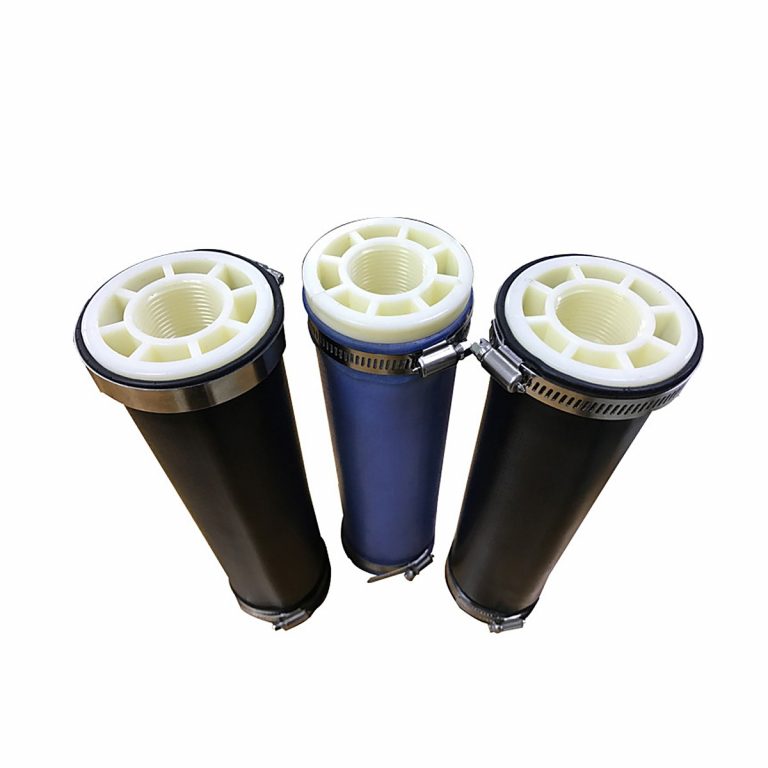
Ask a room of plant operators what MBBR media is and most will describe the object correctly: small plastic carriers, hollow, full of internal fins, tumbling around in an aerated tank. What that description misses is what each carrier actually does. Every one of those little cylinders is a self-contained bioreactor — a protected home where bacteria live, eat and multiply, drifting freely through the wastewater instead of being washed out of it.
That one idea explains both why MBBR retrofits have become the standard low-cost upgrade for older treatment plants, and why some of those upgrades disappoint. This article covers both halves: what the media is and how it works, and the buying mistake that quietly causes most of the failures — treating the media as a commodity you simply pour into a tank.
A home for bacteria that cannot wash away
Conventional activated sludge keeps its bacteria suspended in the water. That works, but the population is hard to hold on to: sludge age is difficult to control, and a shock load or a settling problem can wash your treatment capacity out with the effluent. Fixed media solve the washout problem but need support frames, and they clog and are awkward to inspect or replace.
MBBR (moving bed biofilm reactor) media takes the third route. The carriers are moulded from high-density polyethylene with a density of 0.96–0.98 g/cm³ — just below water — so aeration or a mixer keeps them circulating freely through the whole tank volume. Bacteria colonise the carrier’s internal surfaces and grow there as biofilm. The biomass stays in the reactor because its home stays in the reactor; the treated water leaves through a retention screen whose openings are smaller than the carriers.
The useful measure of a carrier is its protected surface area — the internal area where biofilm can grow sheltered from being scoured off by neighbouring carriers. Across our nine models that runs from above 650 m²/m³ to above 1,600 m²/m³. “Protected” is the word to hold on to when you compare suppliers: a figure is only meaningful if the supplier states which area it counts, and on what basis.
Two zones in every carrier: why nitrogen removal is the headline
A biofilm is not uniform. Oxygen reaches the outer layer easily; the inner layer, against the carrier wall, gets little or none. So a single carrier runs two processes at once:
- Outer layer (aerobic): carbon oxidation and nitrification — ammonia converted toward nitrate.
- Inner layer (anoxic): denitrification — nitrate converted to nitrogen gas.
This simultaneous nitrification and denitrification inside one tank is the main reason MBBR is chosen for upgrades where nitrogen limits have tightened. The plant does not need a new tank to gain a process zone; it gains millions of tiny ones, distributed through the volume it already has.
Why older plants retrofit with it
For an existing plant facing stricter limits or higher load, the attraction is practical:
- No new civil works. The media goes into the existing aeration tank; capacity rises inside the same concrete.
- It tolerates swings. Attached biomass rides out flow and load fluctuations that upset suspended sludge, and there is no sludge return to manage for the biofilm fraction.
- It is added in stages. Fill ratio — media volume as a share of tank volume — typically runs between 15% and 65%, so a plant can start at a lower fill and top up later as load grows.
That combination — more treatment inside the same tank, without rebuilding — is the whole retrofit story. But it comes with a condition, and the condition is where projects go wrong.
Identical-looking carriers are not identical
Two carriers with the same diameter and the same fin pattern can behave very differently in a tank, because the differences are in the material and the density control, not the silhouette:
- Virgin vs recycled HDPE. Recycled feedstock gives uneven density and more brittle walls. In service that shows up as carriers that crack, sink and accumulate in dead zones, or shed fragments — and a biofilm surface that ages early. Every HNS carrier is extruded from 100% white virgin HDPE for exactly this reason; it is also why we state the material grade and density on the quotation, in writing.
- Density outside the band. A carrier denser than water sinks and piles up; one that is too light floats, mats at the surface and washes toward the screen. The working band is narrow — 0.96–0.98 g/cm³ — and it has to hold across the whole production batch, not just the sample.
- Surface area without a basis. A larger number is not a better carrier if nobody can say how it was counted. Ask for the basis before you compare prices per cubic metre.
None of this is visible in a product photo. It is visible, over one or two seasons, in the tank.
The commodity trap: media is one part of a matched set
Here is the misconception that causes most failed retrofits: the idea that MBBR media is a universal consumable — buy it, pour it in at some ratio copied from the internet, and the plant improves. It does not work that way, because the media performs only as part of a set of decisions that have to match your water and your tank:
- Fill ratio follows load, not habit. The right fill depends on your influent BOD/COD, ammonia and treatment target. Too little media and the capacity is not there; too much and circulation suffers, biofilm grows too thick and sloughs, and effluent quality can end up worse than before.
- Aeration has to move the media, not just feed the biology. Air layout and intensity are what keep carriers circulating through the full volume. Dead zones are usually an aeration layout problem wearing a media costume.
- Retention screens are part of the purchase. Slot width must be matched to the carrier’s smallest dimension, with enough open area for peak flow. A screen chosen as an afterthought either loses media downstream or blinds over and raises the water level.
- Start-up is a process, not an event. Biofilm formation typically takes 3–15 days depending on the wastewater and conditions. A plant that judges the media on day three is judging a reactor that has not grown its workforce yet.
A supplier who sells you cubic metres without asking about any of the four is selling you the plastic and leaving you the risk. The questions are not a courtesy; they are how the fill volume gets calculated in the first place.
What to send before you buy
If you are planning an upgrade or a capacity increase, the useful first step is data, not a catalogue. Send:
- Flow (m³/day) and influent BOD/COD and ammonia, as measured — not as designed a decade ago
- Aeration tank dimensions and water depth
- Your treatment target (the limit you must meet, or the load increase you must absorb)
- A photo or the dimensions of any existing carrier and retention screen, if this is a top-up or replacement
With that, model selection and a media-volume calculation are part of our quotation — including an honest answer when the numbers say your constraint is actually aeration or screening rather than media volume. The carriers themselves are made at our own factory in Yixing, China, from 100% virgin HDPE, with a service life above 15 years; samples are cut from production stock, so what you test is what ships.
FAQ
Is MBBR media the same as K1 media?
K1 is one well-known carrier design; “MBBR media” is the category. Carriers differ in size, internal structure and protected surface area. Match a replacement or an equivalent by dimensions and protected surface area — and check your retention screen slots against the carrier size — rather than by name.
How much media does my tank need?
There is no honest universal ratio. The fill ratio runs 15–65% of tank volume depending on load and target. Anyone quoting a volume without your flow and influent data is guessing with your money.
How long until the media starts working?
Biofilm typically forms in 3–15 days. That is a start-up range, not a performance guarantee — biology does not run on a fixed timetable, and a supplier who guarantees one should be asked to put it in the warranty.
Can MBBR media fix a plant that fails on nitrogen?
It is one of the standard tools for exactly that problem, because the biofilm’s inner anoxic zone denitrifies in the same tank. Whether it closes your specific gap depends on your load, tank volume and aeration — which is a calculation, not a slogan. Send the data and we will run it.