Introduction: Respecting the Pioneers
The history of modern wastewater treatment cannot be written without mentioning Kaldnes K1 and AnoxKaldnes K5. These carriers revolutionized the industry by moving from fixed-film to moving-bed reactors. For decades, they have been the “Gold Standard” for municipal and industrial ETPs worldwide.
However, as we enter the era of high-density RAS and compact industrial retrofitting, the physical limits of traditional HDPE (High-Density Polyethylene) are becoming a bottleneck. Today, we benchmark the next generation—NovusPore™—against these industry icons.
1. The Evolution of Surface Area: From 500 to 5000
The primary metric for any MBBR carrier is its protected specific surface area.
- Kaldnes K1 (The Original): Offers ~500 m²/m². It proved the concept but required massive tank volumes for high-load systems.
- AnoxKaldnes K5 (The Upgrade): Improved the design to ~800 m²/m², allowing for more compact reactors.
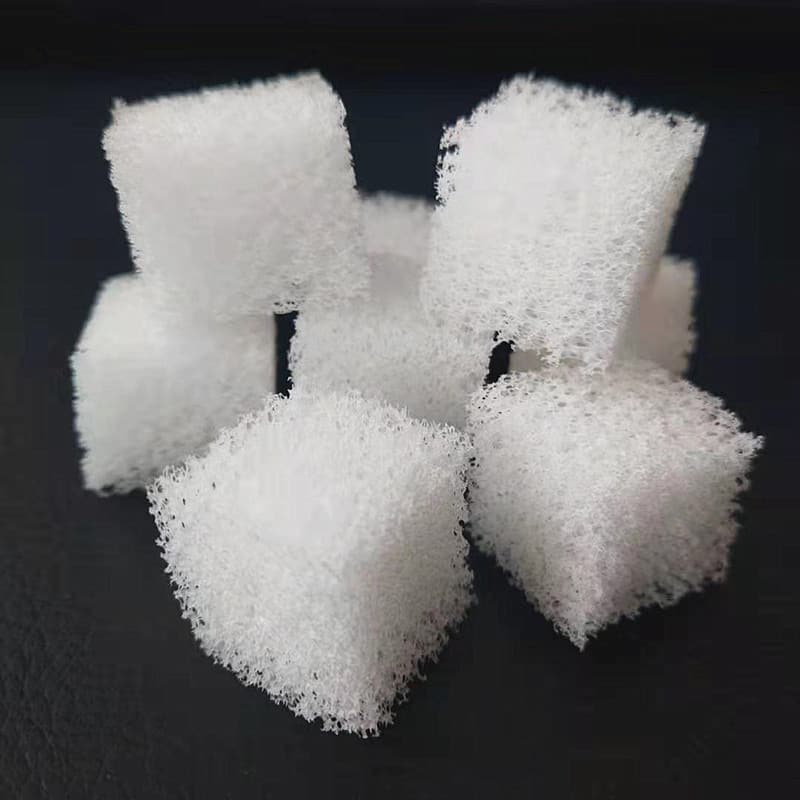
- NovusPore™ (The Revolution): By shifting from a “solid plastic surface” to a 3D Hydrophilic Matrix, NovusPore™ delivers an effective surface area of >5,000 m²/m².
The Result: You can achieve the same nitrification capacity of a K5 system in a tank that is 40% smaller.
2. Material Science: Hydrophobic vs. Hydrophilic
Both K1 and K5 are made of HDPE. While durable, HDPE is inherently hydrophobic (water-repelling).
- The K1/K5 Challenge: Bacteria struggle to “grip” the smooth plastic surface, leading to a 3-4 week startup period and the risk of biofilm “sloughing” during high-flow events.
- The NovusPore™ Advantage: Our modified polymer is hydrophilic. It creates an instant “microbial handshake,” attracting bacteria the second it touches water. This shortens the stabilization period to just 7 days.
3. The “Microbial Bunker” vs. The Open Surface
In high-velocity RAS systems, mechanical shear stress is a silent killer of slow-growing Nitrite Oxidizing Bacteria (NOB).
- K1 & K5: Rely on external fins to protect the biofilm. However, the film remains exposed to water friction.
- NovusPore™: The interlinked 98% porosity structure acts as a “Microbial Bunker.” Bacteria are tucked safely inside the matrix, shielded from shear stress while maintaining perfect mass transfer for oxygen and nutrients.
4. Head-to-Head Comparison Table
| Feature | Kaldnes K1 | AnoxKaldnes K5 | NovusPore™ Matrix |
| Material | HDPE (Hydrophobic) | HDPE (Hydrophobic) | Modified Gel (Hydrophilic) |
| Surface Area | ~500 m²/m² | ~800 m²/m² | >5,000 m²/m² |
| Startup Time | 21 – 28 Days | 14 – 21 Days | 5 – 7 Days |
| Bio-Stability | Moderate | Good | Extreme (Bunker Logic) |
| Logistics ROI | 1 Container = 75m³ | 1 Container = 75m³ | 1 Container = 480m³ (1:6) |
5. The Economic Disruptor: Logistics ROI
For international EPCs and distributors, the biggest “hidden cost” of K1 and K5 is shipping air. Because HDPE carriers cannot be compressed, you pay for the volume of the plastic.
NovusPore™ is shipped in a dry, compressed state and expands 1.7x on-site.
To match the biological capacity of ONE 40HQ container of NovusPore™, you would need to ship SIX containers of standard MBBR.
Conclusion: Is it time to upgrade?
Kaldnes K1 and K5 will always have a place in history. But for modern facilities facing space constraints, high energy costs, and strict discharge limits, the evolution to NovusPore™ is no longer an option—it’s a competitive necessity.
Are you designing a system based on 20-year-old plastic specs?