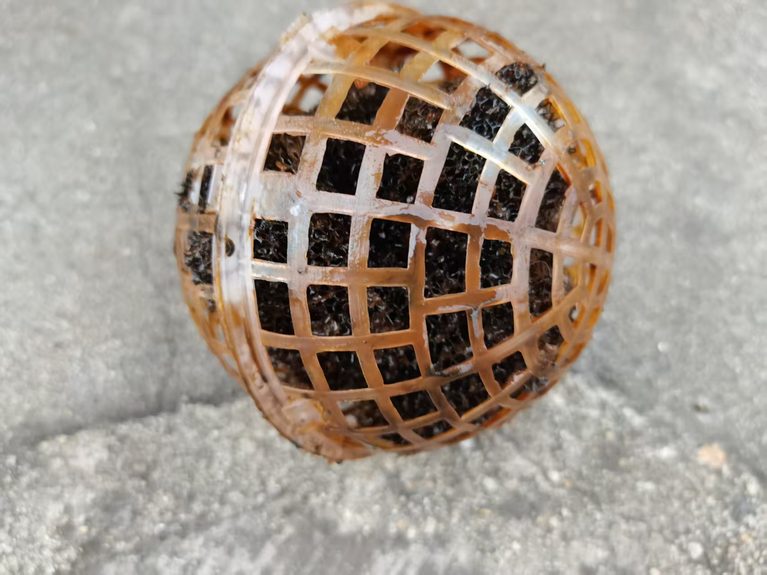
The most common start-up mistake in MBBR is not technical. It is judging the system on day three. New carriers go into the tank clean, white and riding high on the water; a week later there is still little to see; and somewhere in that silence a decision gets made — more chemicals, more air, a complaint to the supplier, sometimes a change of media — just as the biology was getting started.
Biofilm grows on its own schedule. What an operator can control is not rushing it, not starving it, and knowing which week should look like what — so that normal start-up behaviour is not mistaken for failure, and real problems are caught while they are still cheap. Here is the timeline we give buyers with their first fill.
Before day 1 — the checks that decide the next six weeks
- Retention screens confirmed against the carrier’s smallest dimension, edges sealed. Media lost in week one is the most expensive media you will ever buy.
- Aeration running evenly across the grid with the tank at working level. Dead zones found now cost an hour; found in week three they cost a drained tank.
- Seed, if you are using it. Sludge from a healthy plant treating similar wastewater, added at start-up, gives the carriers colonists instead of waiting for whoever drifts in. It shortens the early stages; it does not skip them.
Days 1–3 — the quiet days
What you see: carriers floating high, clumping, some riding the surface. The water looks much as it did before. What is happening: a conditioning film — a molecular layer of organics — is coating the plastic, and the first bacteria are attaching reversibly, testing the surface. None of this is visible, and all of it is necessary.
Operator’s job: keep aeration gentle and even — enough to circulate, not enough to scour. Keep load modest if you have any control over it. Do not dose anything aimed at “speeding up” the film. Our carriers’ stated biofilm formation range is 3–15 days; day three with nothing to see is inside the normal envelope, at the front of it.
Week 1–2 — first film
What you see: carriers begin to ride lower and circulate more willingly as the film adds weight. A faint tan or brown tint appears on the internal surfaces — patchy at first. What is happening: attached bacteria are producing the EPS matrix — the glue of a real biofilm — and microcolonies are establishing. Heterotrophs (the fast growers that remove BOD) lead; the film you can see is mostly them.
Operator’s job: begin feeding load in steps if the plant allows it. Watch BOD/COD removal start to move before ammonia does — that order is correct, not a warning sign. Sponge media runs faster at this stage (our NovusPore sponge forms biofilm in about 3–7 days), which is a property of the material’s pore structure, not a standard to hold HDPE carriers to.
Weeks 2–4 — the nitrification hump
What you see: BOD removal looking respectable; ammonia removal partial and uneven; nitrite sometimes rising before it falls. What is happening: the nitrifiers — slow growers, the aristocracy of the biofilm — are building numbers under the heterotroph layer. The nitrite hump is the classic signature of the second nitrification step (nitrite to nitrate) still catching up with the first. It looks like a problem. It is usually a timetable.
Operator’s job: hold conditions steady — dissolved oxygen and alkalinity are the two that bite; nitrification consumes both. Resist changing two things at once. This is the stage where patience is an operating parameter.
Weeks 4–6 and beyond — maturation
What you see: ammonia removal stabilising; the film a consistent colour and thickness, self-regulating — growing on the inside, sloughing microscopically on the outside. What is happening: the biofilm has reached its working structure: aerobic outer layer, anoxic inner layer, the two-zone arrangement that makes an MBBR carrier a reactor rather than a raft.
Operator’s job: ramp to full load in steps, confirming effluent quality at each step. From here the system is no longer “starting up” — it is operating, and the reference point for its normal is the data from these weeks.
Red flags vs patience — the honest list
Wait it out: clean white carriers in the first days; surface-riding media in week one; BOD improving before ammonia; a nitrite hump in weeks 2–4; total time to stable nitrification running to several weeks, longer in cold water.
Act now: carriers downstream of the screens (a screen problem — every day costs media); a chemical spill or pH excursion upstream (protect the film you have); no visible film and no BOD movement by the end of week two on seeded media (send your supplier the water data — temperature, pH, BOD, ammonia — and the seeding details); aeration visibly uneven with media piled in corners.
What we put in writing
Every first-fill order we ship goes with the formation ranges for the media supplied — 3–15 days for HDPE carriers, 3–7 days for sponge — stated as ranges, because they are. What we will not do, and what you should not accept from any supplier, is a guaranteed calendar date for full nitrification: it depends on your water, your temperature and your load, and a date promised in a sales email is marketing, not microbiology. If start-up stalls past the honest ranges, the data list above is what our engineers will ask for — send it with the first message and the diagnosis starts a week earlier.
FAQ
Can I start up without seed sludge?
Yes — colonists arrive with the wastewater itself. Expect the early stages to run slower, and the week numbers above to stretch. Seeding buys time, not a different outcome.
Does cold water change the timeline?
Yes, at every stage — nitrifiers grow more slowly as temperature falls, markedly below 10 °C. A winter commissioning should be planned with longer allowances (see our winter design guide), not judged against a summer start-up.
The film looks thick and dark. Is that wrong?
Colour alone is a weak signal; thickness that keeps growing without sloughing usually points to load and aeration, not to the calendar. If performance matches the stage you’re in, log it and carry on. If it doesn’t, that’s troubleshooting territory — our symptom-by-symptom guide for existing plants starts there.