Introduction
In Industrial Recirculating Aquaculture Systems (RAS), the speed of system startup and the stability of biological filtration are the lifelines of production. Many engineers struggle with traditional plastic MBBR media, which often suffers from slow biofilm attachment and limited surface area, leading to dangerous ammonia and nitrite spikes during the initial stages.
Today, we explore the synergy between Next-Gen HPU (Hydrophilic Polyurethane) Media and an Industrial-grade Bio-activation Protocol to break the 7-day barrier for stable nitrification.
1. The Material Revolution: Beyond Plastic MBBR
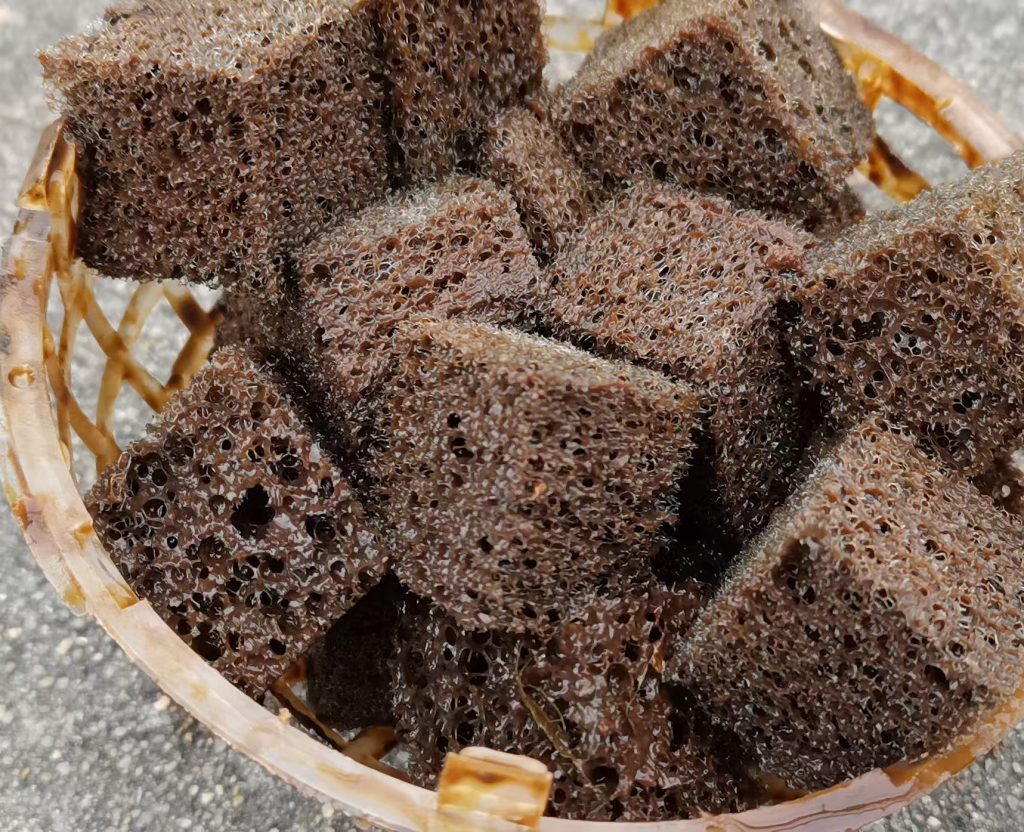
Traditional PE/PP media is hydrophobic, meaning bacteria struggle to “grip” the surface. Our HPU Bio-Sponge changes the game through material science:
- Massive Surface Area (>5000 m²/m²): Provides over 10 times the biological attachment space compared to standard plastic carriers.
- High Hydrophilicity: Modified composite gel ensures microbes attach within hours, not days.
- 98% Porosity: Ensures maximum mass transfer and oxygen delivery to the internal biofilm, preventing anaerobic “dead zones.”
2. The Professional Bio-activation Protocol
Superior media requires a scientific startup. Based on our latest Industrial RAS Bio-activation Strategy (SZG20250929), we recommend a two-phase approach to maximize the efficiency of HPU media:
- Phase I: Preparation (3-5 Days)
Before inoculation, the HPU media must be fluidized in the bio-tank with full aeration. This is when the unique 1.7x Hydro-expansion occurs, opening up the microscopic pores to prepare for microbial colonization. - Phase II: Rapid Inoculation (Achieving Stability in 5-7 Days)
By introducing high-activity nitrifying bacteria (such as the BioClean series) alongside specialized nutrient solutions, the porous HPU structure acts like a “biological magnet.” Unlike plastic media where bacteria are easily washed away, HPU traps the microbes within its hydrophilic matrix, accelerating the nitrogen cycle.
3. Precision Environment Control
To achieve elite nitrification levels, environment control is paramount. Our data suggests the following benchmarks for optimal HPU performance:
- Dissolved Oxygen (DO): Maintain ≥ 4.0 mg/L.
- Temperature: 25°C–35°C (28°C is the “Sweet Spot”).
- pH & Alkalinity: Maintain pH between 7.5 and 8.5. Using Sodium Bicarbonate (50–150g per m³) ensures sufficient inorganic carbon for nitrifying bacteria to thrive.
4. Why Industry Leaders are Switching to HPU
The shift from traditional plastic to HPU Sponge Media is driven by results:
- Rapid NH3-N Reduction: Faster elimination of toxic nitrogen compounds during peak feeding.
- System Compactness: Higher surface area allows for 30-50% smaller bio-tanks, significantly reducing facility construction costs.
- Logistics Optimization: HPU is shipped in a dry, compressed state. Because it expands 1.7x upon wetting, you effectively cut your international freight budget in half.
Conclusion
In modern RAS operations, time is money and water stability is security. HNS Watertech provides more than just high-performance media; we provide the technical roadmap to a safer, more efficient biological system.
Want to receive the full “Bio-activation & Biofilm Protocol” PDF or request a testing kit for your facility?
Leave a comment with “YES” below or send a direct message to Lydia. Let’s optimize your water quality together!
#RAS #Aquaculture #Biofiltration #ShrimpFarming #WastewaterTreatment #Sustainability #HPUmedia #HNSWatertech