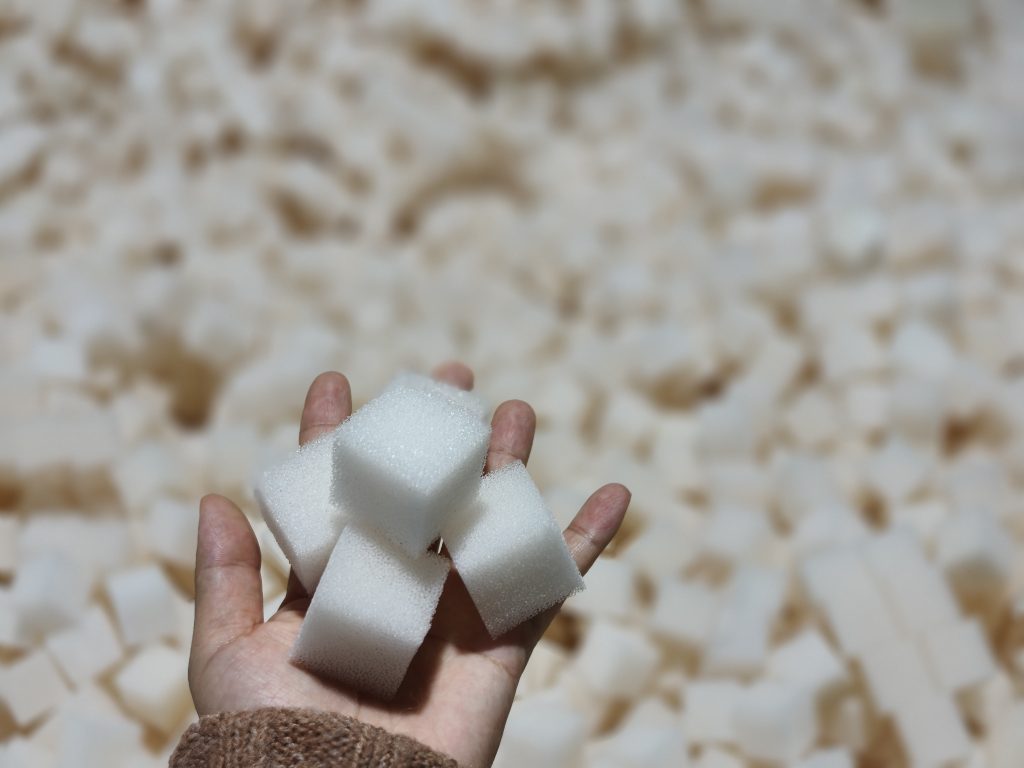
Are your aeration tanks reaching their limit? For decades, HDPE Plastic MBBR media has been the industry standard. It’s reliable and durable. But what happens when your wastewater plant needs to handle double the load without doubling the tank size? Construction of new concrete tanks is expensive and time-consuming. Sometimes, you simply don’t have the land. This is where Polyurethane (PU) Sponge Media comes in. Think of it not just as a replacement, but as a “turbocharger” for your existing biological system.
The “When”: 3 Signs You Need Sponge Media
You don’t need to switch to sponge for every project. Plastic media is fine for standard loads. However, you should consider upgrading to HNS Sponge Media in these specific scenarios:
1. Limited Footprint (No Space to Expand) If your COD/BOD levels have increased but your tank volume is fixed, plastic media (with ~500-800 m²/m³ surface area) might hit a performance ceiling. You physically cannot put enough plastic in the tank to handle the bacteria needed.
2. High Ammonia Nitrogen Requirements Nitrifying bacteria are slow growers and sensitive. The porous structure of sponge media protects these fragile bacteria from shear forces better than the smooth surface of plastic rings, making it ideal for strict ammonia discharge limits.
3. Rapid Startup Is Crucial Plastic media can take weeks to develop a biofilm. Sponge media, being highly hydrophilic (water-loving), absorbs water instantly. This allows microorganisms to colonize the interior pores in days, not weeks.
The “Why”: The Science of Surface Area
The biggest difference is simple geometry.
- Standard HDPE Media: ~800 m²/m³
- HNS Sponge Media: ~2500+ m²/m³
The “Apartment Complex” Analogy: Imagine your bacteria are tenants. Plastic media is like a single-story house. The bacteria only live on the roof and walls. If the water flow is too strong, they might get washed off. Sponge media is like a skyscraper with thousands of rooms inside. The bacteria live inside the protected pores of the sponge. Even during high turbulence or aeration, the biomass stays safe inside.
Engineer’s Note: Durability Concerns
“Doesn’t sponge degrade after a year?” We hear this question often. It is true for cheap polyester-based sponges. They hydrolyze (break down) in water. At HNS Water Tech, we use Polyether-based PU foam.
Mechanical Strength: Our 20mm/30mm cubes are cut to withstand the friction of tumbling in aeration tanks. We don’t sell mattress foam; we sell engineering-grade bio-carriers.
Hydrolysis Resistant: Designed specifically to be submerged in water for years.
Is It Right for You?
Switching media isn’t just about buying a different product; it’s about calculating the right Filling Ratio (10% to 30%). If you are planning an upgrade for a Paper Mill, Textile Plant, or Municipal STP, don’t build a new tank yet. Contact HNS Water Tech today. Let us calculate if switching to Sponge Media can save you the cost of construction.